
Use the promo code to enjoy a 10% discount storewide.
Your Office Sets the Light. You Can Still Choose the View.

Quick Summary
- Office lighting is personal. The same lighting can feel comfortable to one person and harsh to another.
- Color accuracy and visual comfort are different priorities. Tinted lenses change how colors and light appear.
- Daytime Focus Yellow: A brighter, gently warm view for everyday screen work and detailed tasks.
- Daytime Focus Warm Yellow: A softer, more subdued view for bright or visually intense office environments.
- Choose based on your tasks and preferences. Use a neutral view when accurate color perception is essential.
Your office picked the ceiling lights. Your laptop picked the white background. But you still have one choice left: how that light reaches you.
Most daytime glasses are sold around one idea. The best lens is the lens you barely notice. Whites should stay white. Every color should remain exact.
But is that what every office worker wants?
Some people need accurate color. Others would gladly trade a little neutrality for a workspace that looks warmer, softer, and less stark.
A visible tint is not always a flaw. Sometimes, it is the feature.
Color accuracy and visual comfort are different goals
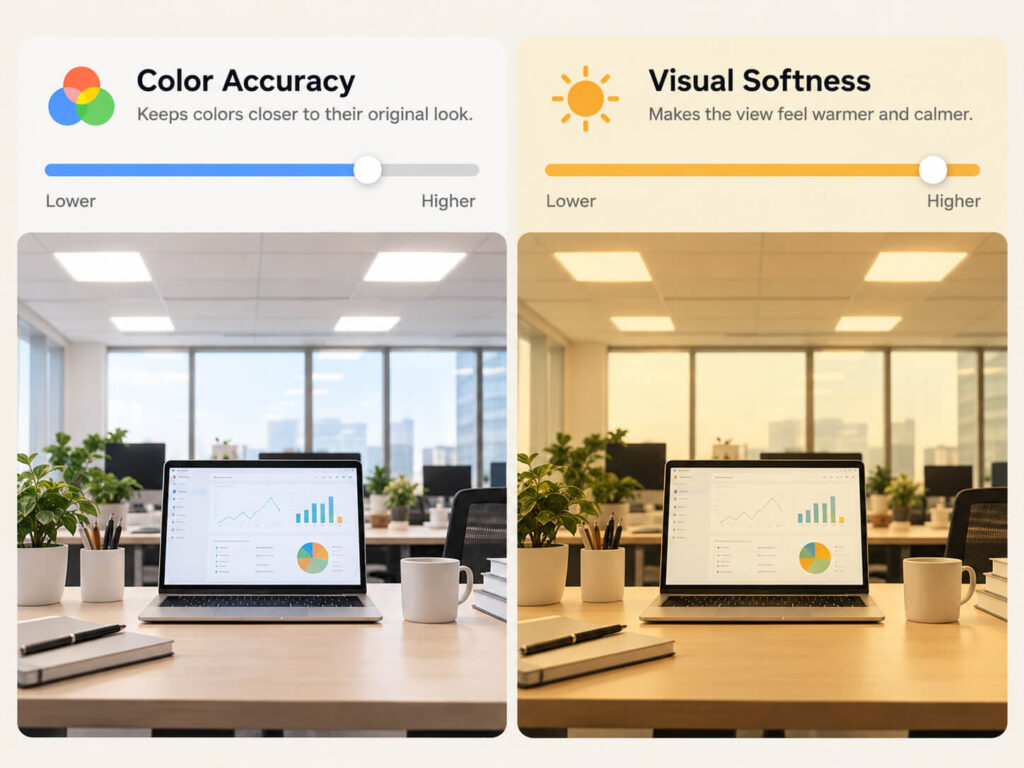
Color fidelity matters when color is part of the work. Think photo editing, print approval, medical imaging, product design, or matching a brand color.
Most office hours look different. They are spent reading email, checking numbers, writing reports, joining calls, and moving between browser tabs. In those moments, a perfectly neutral white may matter less than the overall feel of the room.
A tint changes color. That should be stated clearly. Yet the change can be intentional. A gentle yellow tone can make a cold-looking screen appear warmer. A deeper warm yellow can make white walls and overhead lights look more subdued.
The question is not only, “Which lens changes color the least?”
It is also, “What kind of view do I want to work in?”
The same office does not feel the same to everyone
One coworker calls the room bright and energizing. The person at the next desk calls it harsh. Both can be describing the same ceiling lights.
A controlled study of office-style lighting found considerable differences in individual preferences. The researchers concluded that designs based only on averages may miss what people actually want. They supported lighting that people could adjust for themselves. Read the study on individual lighting preferences.

That study was about room lighting, not tinted glasses. Still, it supports a useful idea: there is no single office-light experience that suits everyone.
Think of tint as a personal light setting
You may not control the fixtures above your desk. You may not be allowed to dim an open-plan office, replace the bulbs, or move away from a bright window.
A lens tint gives you one portable layer of control. It does not change the building. It changes the light reaching your eyes and the way the room appears through the lens.
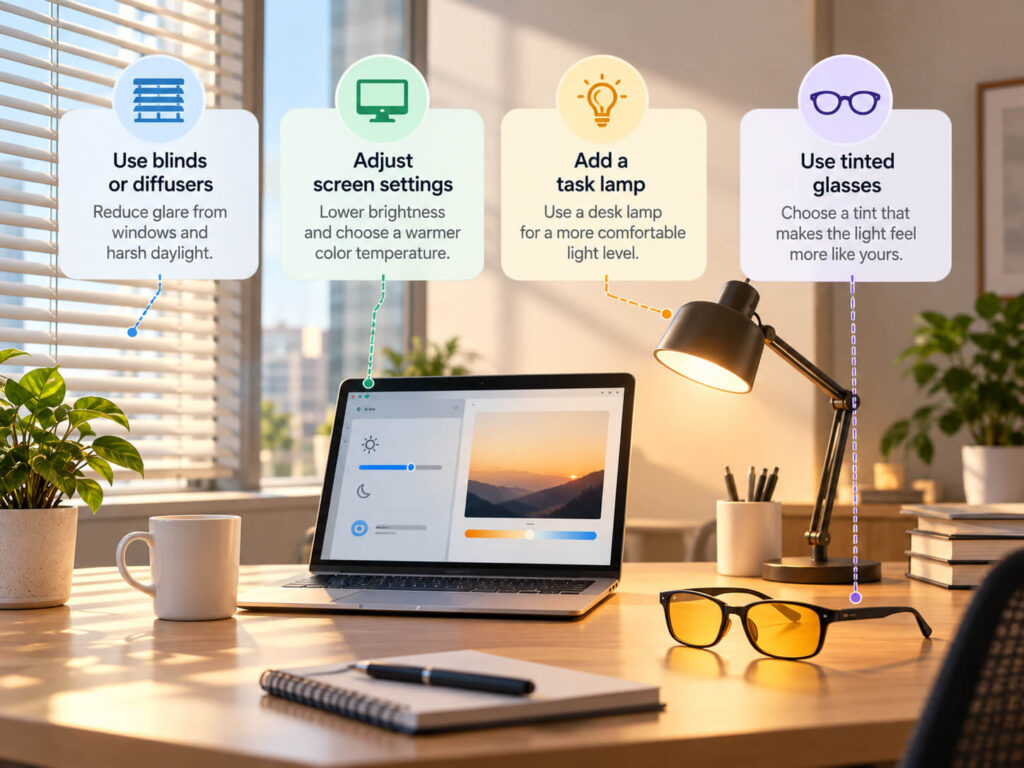
Glasses should not be the only adjustment. OSHA also recommends reducing glare, repositioning screens, using blinds or diffusers, and matching lighting to the task. Its computer workstation guidance offers practical ideas.
Move the monitor. Lower the brightness. Close the blind. Add a desk lamp. Then decide whether a chosen tint would make the remaining light feel more like yours.
Two tints. Two ways to shape the workday.
Gloojo Daytime Focus Glasses give office users two different views. One is not the premium version of the other. The better choice depends on your tasks, your room, and your preference.
| Choice | How the view looks | A natural fit when… | Honest tradeoff |
|---|---|---|---|
| Daytime Focus Yellow | Bright, clear, and gently warm | You read fine text, work on screens, or want an easy first tint | Colors look warmer than they do through a clear lens |
| Daytime Focus Warm Yellow | Softer, warmer, and more subdued | Overhead lights or a visually busy room feel too intense | The warm color shift is more noticeable |
Choose Yellow for a bright daytime feel
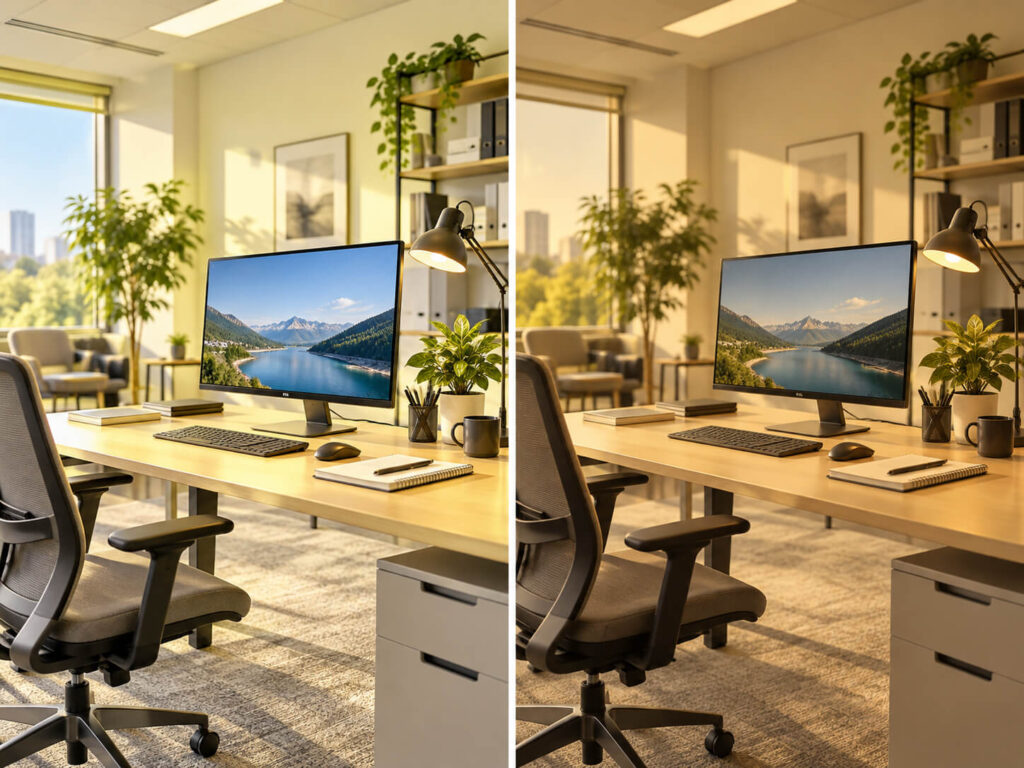
Daytime Focus Yellow has higher light transmission. It keeps the room looking bright while adding a gentle yellow tone. It is an easy starting point for spreadsheets, reading, coding, and detailed screen work.
Choose it if you want to change the view without making the office feel too subdued.
Choose Warm Yellow for a softer room
Daytime Focus Warm Yellow has lower light transmission and a more visible warm tone. It changes the feel of the whole space more clearly. Bright interfaces, white walls, and overhead lights can look warmer and less stark.
Choose it when the room itself bothers you more than the screen alone.
Selected Daytime Focus frames are also available with single-vision or progressive prescription lenses.
Choose by task, not by a promise of “perfect” vision
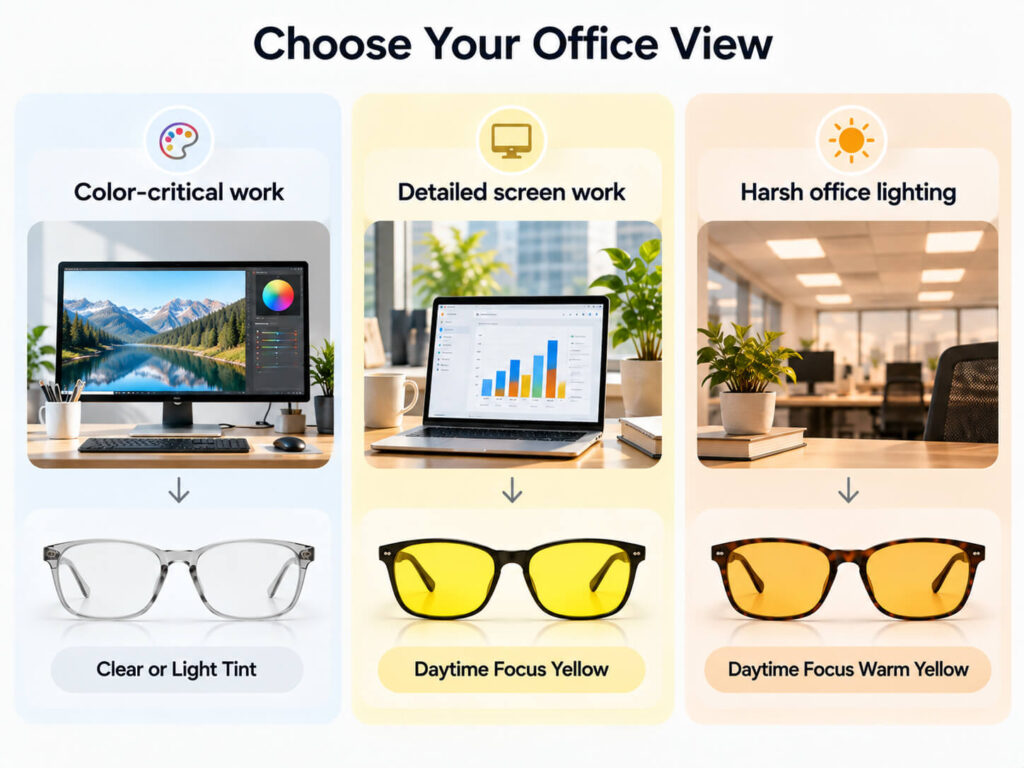
Use the most neutral view when exact color is essential. Remove tinted glasses for a final design, print, paint, or product-color check.
For everyday office work, ask different questions:
- Do I want the room to stay bright and active? Start with Yellow.
- Do I want the whole room to look softer and warmer? Consider Warm Yellow.
- Does one meeting room feel harsher than my desk? Wear the tint only where you want it.
- Does the tint make a task harder? Take it off for that task.
Try the view during a real workday. Open the bright spreadsheet. Join the video call. Walk through the break room. Read a printed page. Notice the room at 10 a.m. and again at 3 p.m.
Your own day will tell you more than ten seconds in front of a mirror.
Stop treating office light like weather

Office light often feels like something you simply have to accept. It does not have to be completely outside your control.
The right office lens is not always the one that disappears. Sometimes it is the one that makes a cold, demanding space feel a little more like your own.
Explore Gloojo Daytime Focus Yellow and Warm Yellow and choose the view you want to work in.
Disclaimer
Daytime Focus glasses are light-management products. They do not diagnose, treat, cure, or prevent eye disease or digital eye strain. Persistent eye pain, headaches, blurred vision, or unusual light sensitivity should be discussed with an eye-care professional.