Use the promo code to enjoy a 10% discount storewide.
Dark Red vs. Red vs. Orange Sleep Glasses: Which Night Ease™ Tint Should You Choose?
Quick Summary
- Best overall choice: Red for most first-time buyers.
- Stronger isn't always better: Comfort and visibility matter.
- Third-party tested: All three tints show strong melanopic-light reduction.
- Choose for your routine: The best lens is one you'll actually wear.
- Safety first: Not suitable for driving.
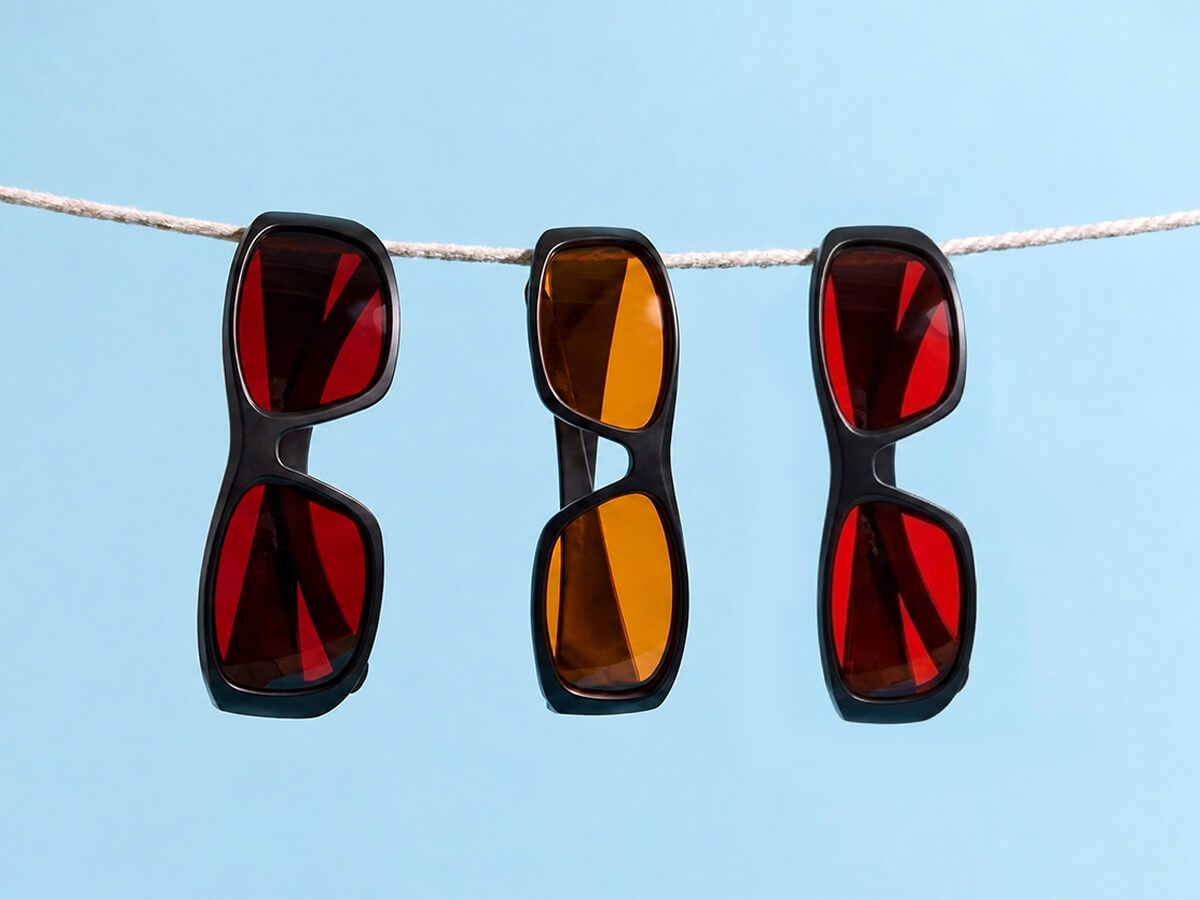
Quick answer: Choose Dark Red for maximum light reduction. Choose Red for the best balance of strong filtering and usable vision. Choose Orange if you want to wear your glasses earlier while cooking, watching TV, or spending time with family.
For most first-time buyers, we recommend Red.
Each Gloojo Night Ease™ lens has a different job. The best choice depends on when you put it on and how much you still need to do before bed.
Night Ease™ tints at a glance
| Tint | Best for | When to wear | What to expect |
|---|---|---|---|
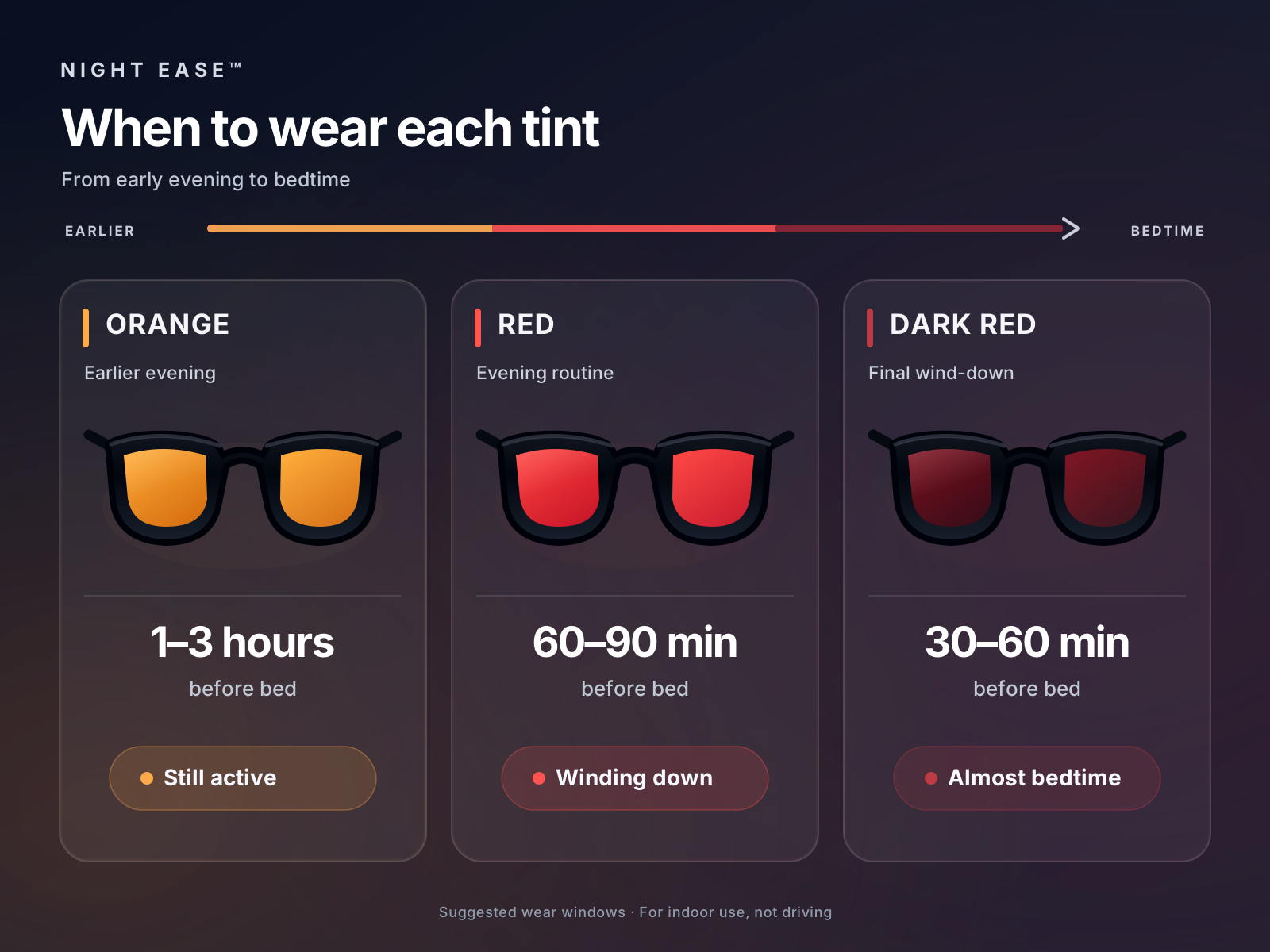
| Dark Red | Maximum evening light reduction | 30–60 minutes before bed | Very dark and deeply red |
| Red | The strongest practical everyday choice | 60–90 minutes before bed | Strong red tint with better visibility |
| Orange | Starting your wind-down earlier | 1–3 hours before bed | Brighter, warmer, and easier to wear longer |
What did third-party testing find?
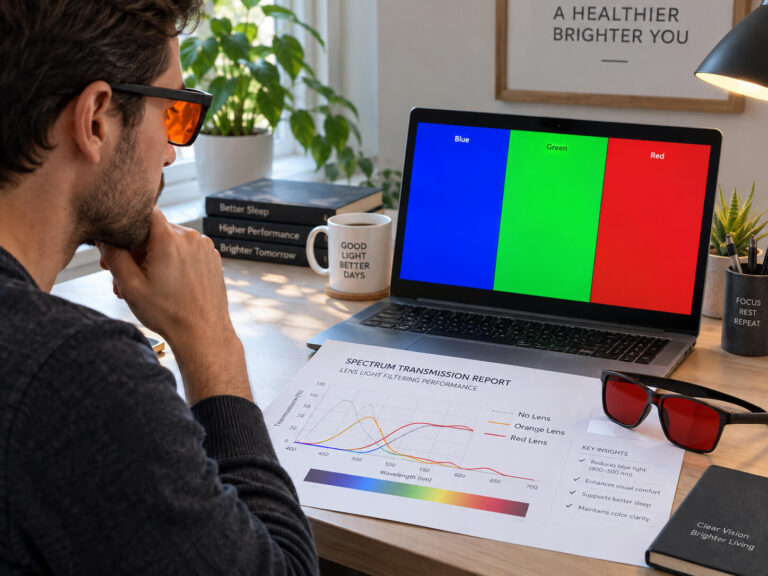
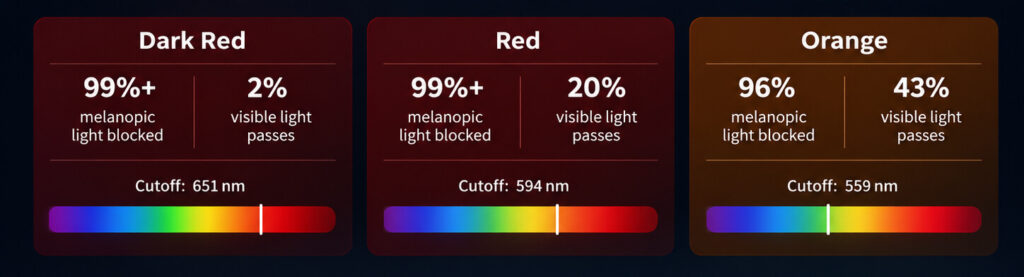
Gloojo provides its own spectral reports for all three lenses. The lenses were also measured by the third-party testing site Optimize Your Biology, using spectral transmission data across 350–950 nm.
| Lens | Melanopic light blocked in third-party test | Visible light passing through | Reported cutoff |
|---|---|---|---|
| Dark Red | 99%+ | 2% | Below 651 nm |
| Red | 99%+ | 20% | Below 594 nm |
| Orange | 96% | 43% | Below 559 nm |
These are third-party optical measurements. They are not a promise that everyone will sleep better. They do show a clear difference in strength and brightness.
The results also match the pattern in Gloojo’s supplied reports: Dark Red lets through the least visible light, Red sits in the middle, and Orange is the brightest.
Choose Dark Red for maximum evening darkness
Night Ease™ Dark Red is the strongest option. It is made for the final part of the night, when the dishes are done, the doors are locked, and you are ready to stop moving around.
Third-party testing found that Dark Red blocked 99%+ of melanopic light and allowed only 2% of visible light through. At the time of testing, it ranked first for melanopic-light blocking among 61 lenses in the tester’s database. See the full Night Ease™ Dark Red test results.
Choose Dark Red if:
- Bright rooms make it hard for you to switch into bedtime mode.
- You still use a phone or TV shortly before bed.
- You want the strongest light reduction in the Night Ease™ range.
- You will mostly sit, listen to audio, or get ready for sleep.
The tradeoff is simple: Dark Red is very dark. Colors look muted, and walking around is less convenient.
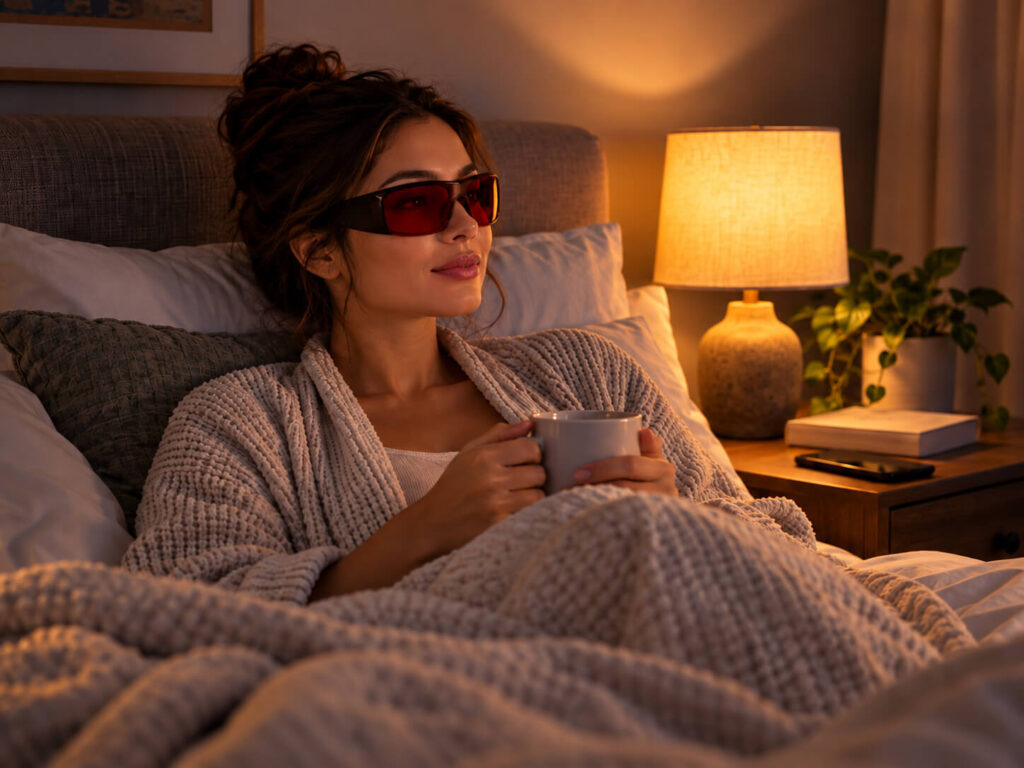
Best for: Maximum strength during the last 30–60 minutes before bed.
Choose Red for the best overall balance
Night Ease™ Red is our recommendation for most people. It gives you strong filtering without making the room as dark as the Dark Red lens.
The third-party test measured 99%+ melanopic-light blocking with about 20% visible-light transmission. It ranked seventh among the 61 tested lenses for melanopic-light blocking. View the full Night Ease™ Red test results.
Choose Red if:
- This is your first pair of sleep glasses.
- You want strong filtering but still need to move around the house.
- Your normal evening includes TV, texting, or getting things ready for tomorrow.
- You want one tint that fits most bedtime routines.
You will notice a strong red color shift. But compared with Dark Red, it is much easier to use while packing lunch, filling your water bottle, or setting the coffee maker for morning.
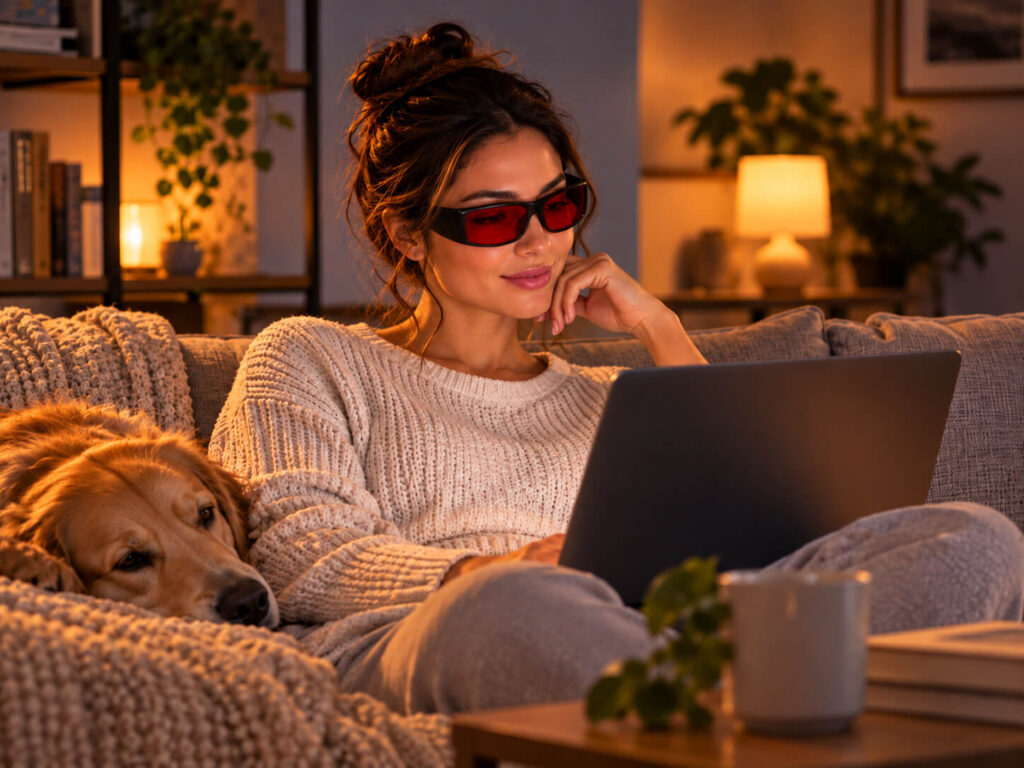
Best for: A strong and practical wind-down 60–90 minutes before bed.
Choose Orange for an earlier start
Night Ease™ Orange is the lightest of the three. It is a better fit if you want to put your glasses on well before your final bedtime routine.
Third-party testing found 96% melanopic-light blocking and about 43% visible-light transmission. The tester described it as a strong evening lens and noted that Red is the stronger choice under bright overhead LEDs. See the full Night Ease™ Orange test results.
Choose Orange if:
- You want to start reducing short-wavelength light earlier.
- You still cook, clean, read, or spend time with family.
- You prefer a brighter view.
- Deep red lenses feel too intense.
Orange keeps more of the room visible. It is the easiest tint to wear while you finish the normal details of an American evening, from loading the dishwasher to letting the dog out one last time.
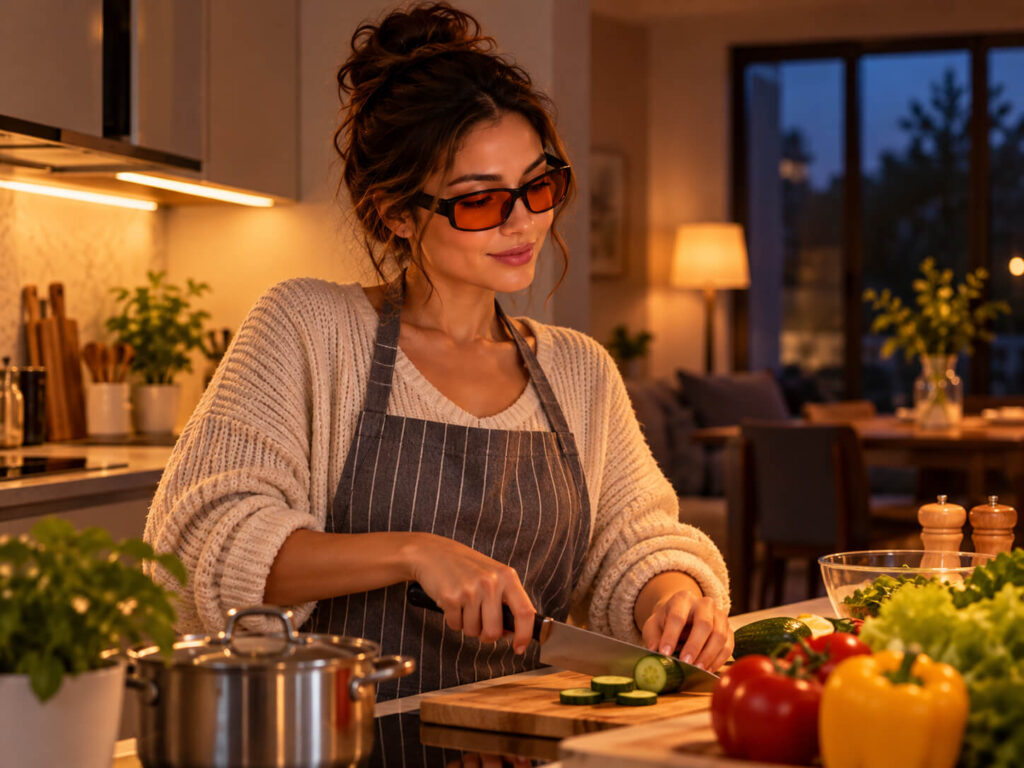
Best for: Longer wear during the one to three hours before bed.
Is darker always better?
No. The strongest lens is not automatically the best lens for your life.
If Dark Red is too dark to wear safely, Red is the better choice. If Red goes on too late because you are still busy, Orange may be more useful. A lens only helps your routine when you actually wear it.
Use this simple rule:
- Still active? Choose Orange.
- Winding down? Choose Red.
- Almost ready for bed? Choose Dark Red.
Which Night Ease™ tint should you buy?
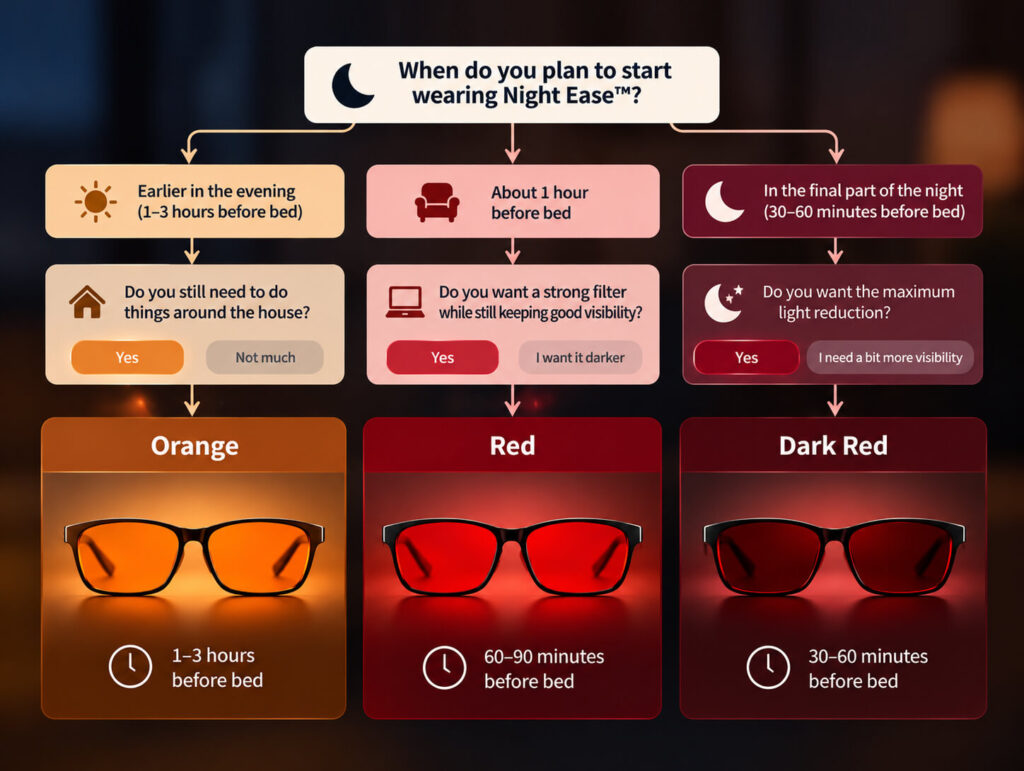
Buy Dark Red if maximum light reduction matters more than visibility.
Buy Red if you want the best all-around recommendation. It gives you third-party-measured 99%+ melanopic-light blocking while remaining much brighter than Dark Red.
Buy Orange if comfort, movement, and longer wear matter most. It is less aggressive than Red, but much easier to use during an active evening.
Important safety note
Do not drive while wearing any of these Night Ease™ lenses. The supplied reports classify Dark Red, Red, and Orange as unsuitable for driving or road use. Strong tints change color perception and may make hazards harder to see.
These glasses are tools for managing evening light. They are not medical treatments for insomnia. Research on blue-light-filtering glasses and sleep remains mixed, as summarized in this Cochrane evidence review.
Final recommendation
For most people, start with Night Ease™ Red.
Choose Orange if you want to begin earlier. Move up to Dark Red if you want the most immersive final wind-down and do not mind very low visibility.
The third-party tests make the difference clear. Dark Red is maximum strength. Red is the best balance. Orange is the easiest to wear longer.
Compare all three Night Ease™ tints and choose your frame.
Disclaimer
This article provides general educational information. It does not replace advice from an eye-care or healthcare professional.