Use the promo code to enjoy a 10% discount storewide.
Why We Developed Gray Relief: A Different Approach to Migraine Light Sensitivity
Quick Summary
- Gray Relief: A near-neutral alternative to rose-tinted FL-41 lenses.
- Dual-Notch Design: Two filtering valleys at 500 nm and 580 nm.
- Green-Light Window: Higher transmission between 520–550 nm.
- Light Transmission: 38.07% VLT, with independent testing by OYB.
- Everyday Comfort: Less noticeable color distortion for daily use.
Light sensitivity can make an ordinary workday feel anything but ordinary. Overhead LEDs, bright screens, and reflections may all add to visual discomfort for people who experience migraine-related light sensitivity. But the answer is not always to make everything darker—or to make everything pink.
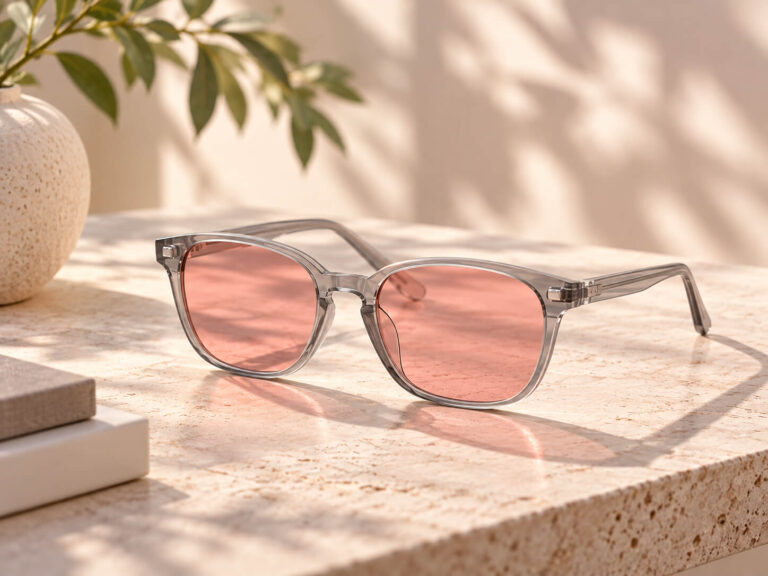
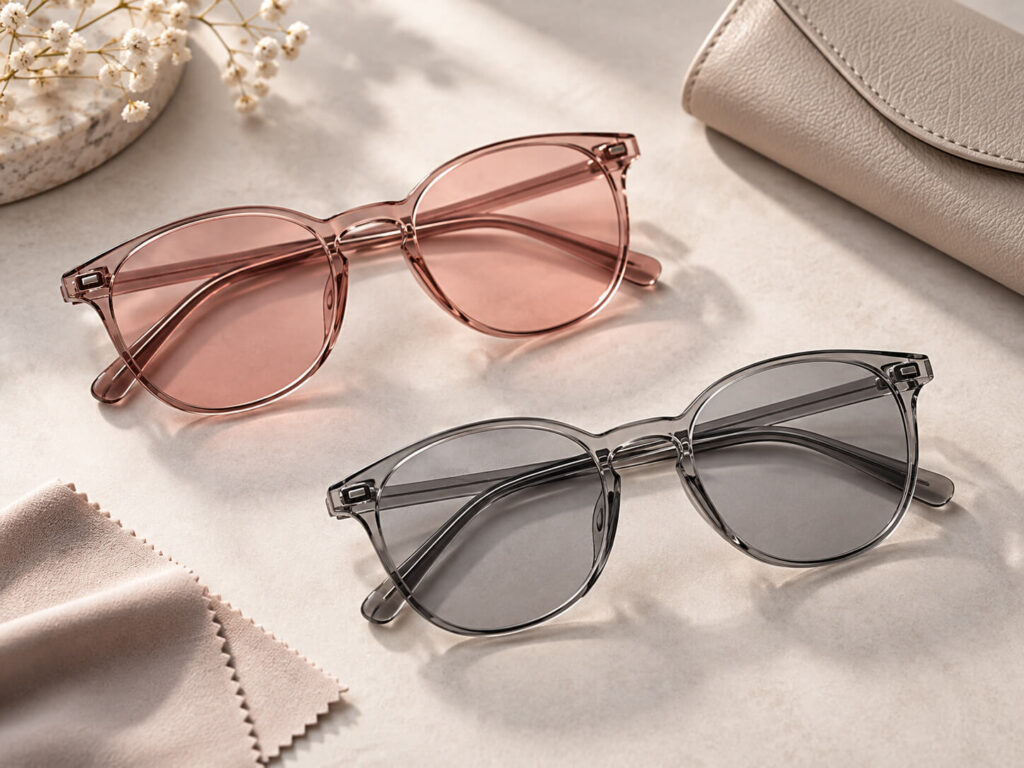
At Gloojo, we began with Rose Relief™, our rose-tinted, FL-41-inspired option. Rose-colored filters have a long history in discussions of migraine-related photophobia, but their color shift is noticeable. A white page looks tinted; skin tones and screen colors change with it.
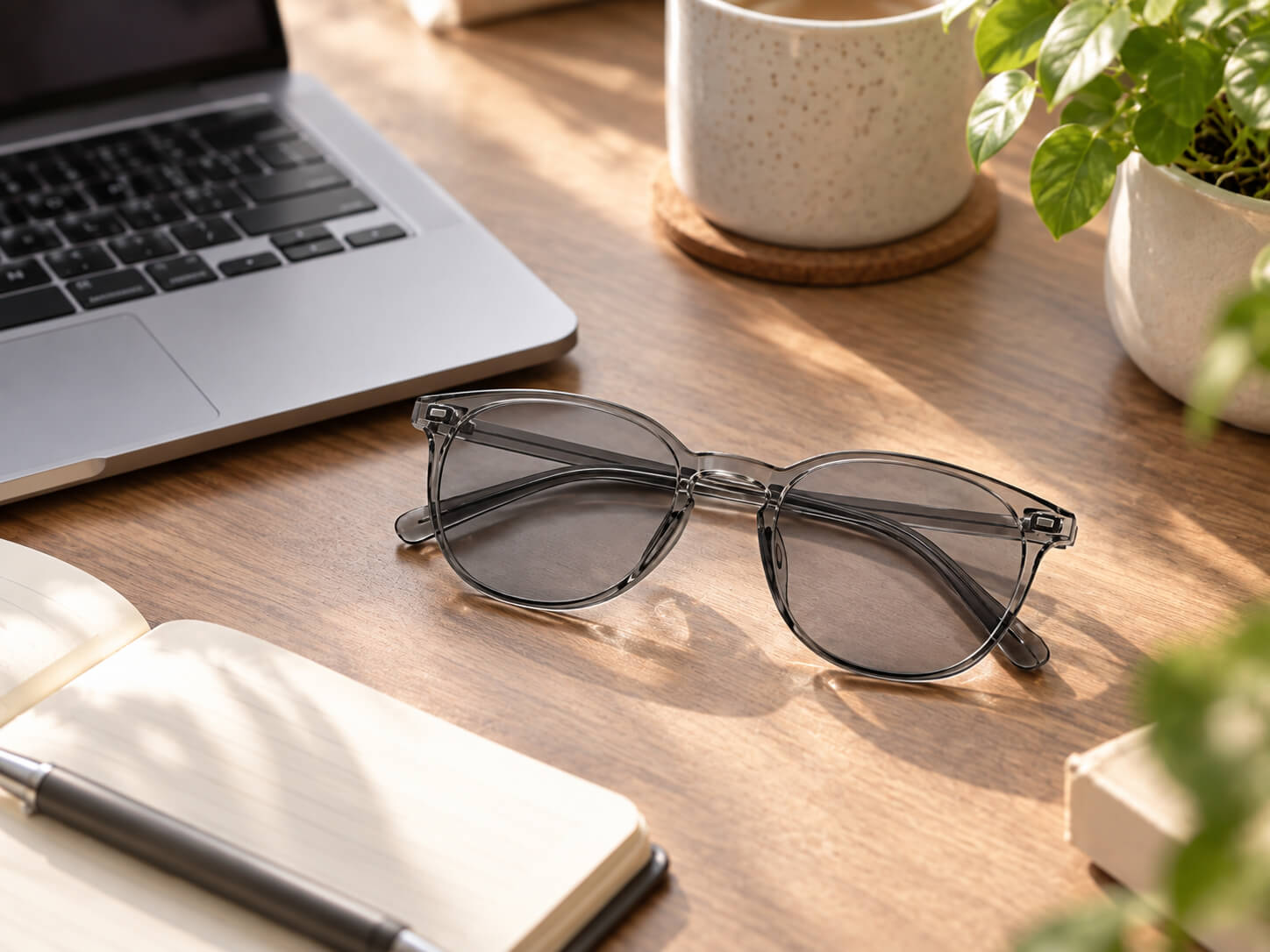
We wanted to offer another choice: a lens that uses selective filtering while keeping the everyday view closer to neutral gray. That led to Gray Relief.
Why Dual-Notch Filtering Matters
A notch is a dip in a lens’s spectral transmission curve—a wavelength region where less light passes through. A dual-notch design has two such dips, with a relatively higher-transmission region between them.
Gray Relief was developed with two filtering valleys and a green-light transmission window between them. Rather than reducing every wavelength by the same amount, its measured curve changes how much light passes through different parts of the visible spectrum.
There is a scientific reason to take wavelength differences seriously. In a 2016 study published in Brain, researchers found that green light aggravated migraine headache less than white, blue, amber, or red light among the participants studied. That finding helped inform interest in wavelength-selective approaches to light sensitivity.
An important distinction: the study did not test Gray Relief, and allowing relatively more green light through a lens is not the same as demonstrating a clinical benefit. Gray Relief’s spectrum describes its optical design—not a proven treatment for migraine.
The Measured Gray Relief Spectrum
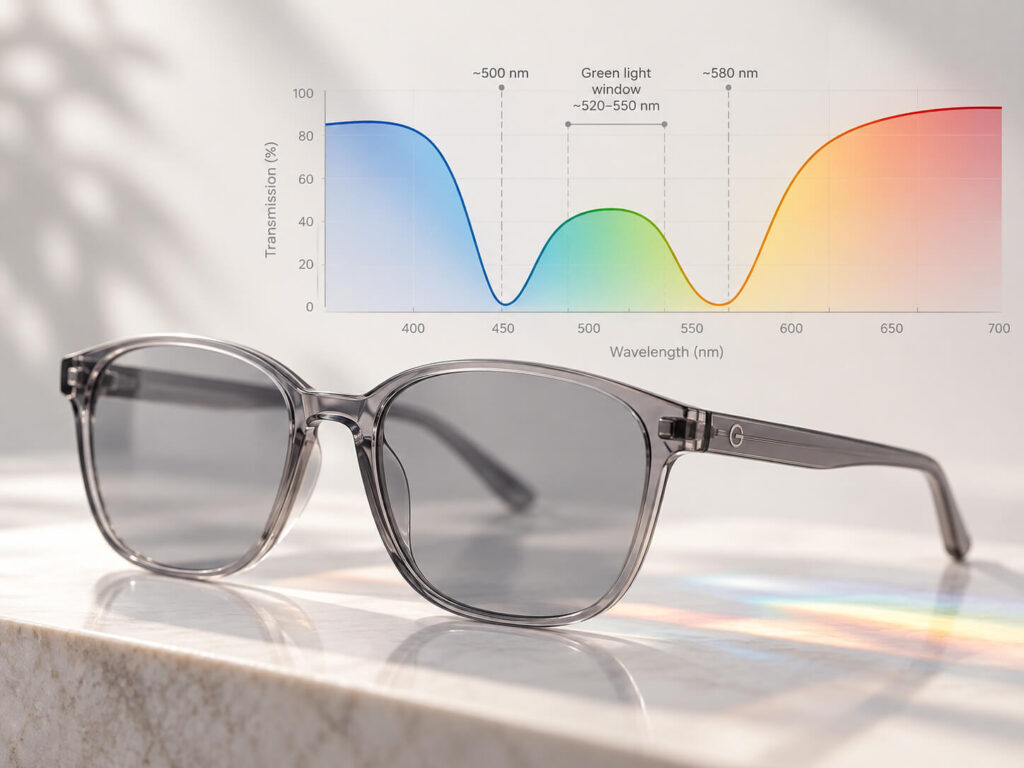
The spectral report for Gray Relief lens PC3702S, as recorded in our product documentation, shows the structure of its filter:
500 nm: 15.37% transmission at the first measured valley.
520–550 nm: approximately 49%–51% transmission, forming a higher-transmission green-light window.
580 nm: 10.68% transmission at the second measured valley.
The same report gives a 38.07% visible light transmittance (VLT) and 62.54% blue-light absorption under its test conditions. In practical terms, the lens reduces a substantial amount of overall visible light, while filtering some wavelengths more strongly than others.
The values describe measurable light transmission. They do not, on their own, establish how much relief any individual wearer will experience.
A Near-Neutral Gray Tint, Not Color-Free Vision
The spectrum was only part of our design goal. We also wanted a lens that did not give the world the pronounced rose cast associated with traditional pink filters.
The PC3702S report records a*=0.48 and b*=-0.68 on the CIE L*a*b* color axes. Values near zero on these two axes indicate limited red–green and yellow–blue bias under the stated measurement conditions. This supports describing Gray Relief as near-neutral, not completely colorless.
An independent test by Optimize Your Biology measured approximately 42% visible light transmission and described the tint as light grey, with colors shifting slightly warm. This is a separate measurement from Gloojo’s 38.07% report; results can vary with the sample and testing method.
That difference matters when setting expectations. Gray Relief may look more natural than a distinctly rose-colored lens, but it still darkens the view and changes some colors. It should not be treated as a clear lens or used where precise color judgment is essential.

Rose Relief or Gray Relief: Which Fits You?
Both lenses are designed for people looking to manage uncomfortable light. They simply make different tradeoffs.
| Rose Relief™ | Gray Relief | |
|---|---|---|
| Lens approach | Rose-tinted, FL-41-inspired filtering | Measured dual-notch filtering with a green-light window |
| Color experience | Noticeable rose cast | Near-neutral gray with some warmth and darkening |
| Consider it if | You prefer an established rose-tint approach | You prefer a less visibly pink viewing experience |
| Prescription options | Prescription options available | Currently non-prescription; selected fit-over options available |
Neither lens is a one-size-fits-all answer. Lighting conditions, individual sensitivity, the task you are doing, and the amount of light you need to see comfortably all matter.
A Different Option for Light-Sensitive Days
Gray Relief started with a simple product question: Could we make wavelength-selective filtering feel more practical for people who don’t want a visibly pink lens?
Our answer is a measured dual-notch curve, a relatively open green-light window, and a gray tint that stays closer to neutral than a traditional rose lens—without pretending that color is completely unchanged.
Explore Gloojo Gray Relief migraine glasses, starting at $99, and learn more about our 60-day comfort trial and return terms. Return shipping costs may apply.
Gray Relief is an optical light-management product, not a cure for migraine or a substitute for medical care. If headaches are new, severe, changing, or disrupting daily life, seek advice from a qualified healthcare professional.
Disclaimer
This article provides general educational information. It does not replace advice from an eye-care or healthcare professional.