Use the promo code to enjoy a 10% discount storewide.
How to Test Blue Light Glasses: What Home Tests Can Really Tell You
Quick Summary
- Home tests can show how lenses change visible colors.
- RGB and flashing tests are useful for quick comparisons.
- LED pen tests only check the pen’s specific light.
- Home tests cannot show exact blocking percentages.
- Lens tint or reflection does not prove filtering strength.
- A spectral report shows which wavelengths are reduced.
- Home tests do not prove sleep or eye-strain benefits.
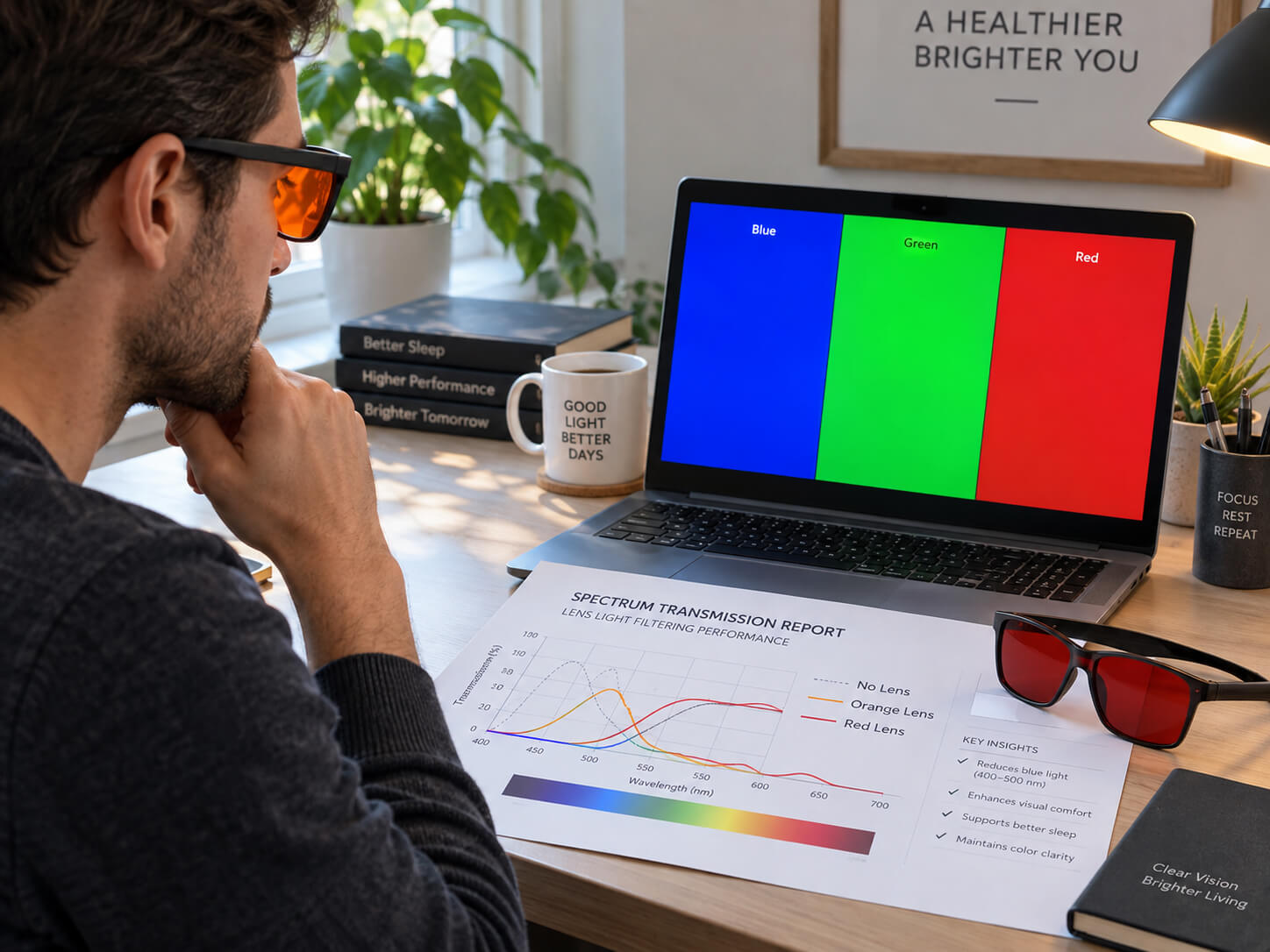
You can test blue light glasses at home with a white background, an RGB color chart, a flashing blue-and-black screen, or a blue LED light. These checks can reveal visible color changes and help you compare two lenses. They cannot measure an exact blocking percentage. For that, you need a wavelength-by-wavelength spectral transmittance report from a spectrophotometer.
Why should you test blue light glasses?
You put on a new pair of blue light glasses. The world looks warmer. A blue screen appears darker. The lenses clearly change the light you see.
But what does that prove?
It proves that the lenses alter some visible light. It does not tell you the exact wavelengths they filter. It also does not tell you the percentage blocked at each wavelength.
This distinction matters because blue light glasses are not all the same. A nearly clear daytime lens may make only a small visual change. An amber, orange, or red lens may change colors much more. The lenses may be designed for different times and different light environments.
Research on commercial blue-filtering lenses shows that their spectral transmission can vary widely. In one optical study, researchers used a UV-visible spectrophotometer to measure how much light passed through each lens across the visible spectrum (PubMed). That type of measurement gives much more information than a visual home test.
A home test can be useful. It should be treated as a quick check, not as a laboratory result.
What does “blocking blue light” actually mean?
Visible light contains many wavelengths. Blue light is not one single point. It covers a range of shorter visible wavelengths.
A lens may reduce one part of that range while allowing another part to pass. A product may also reduce green light, violet light, or overall brightness. That is why one large “blue light blocking” percentage can be hard to interpret without more detail.
The most useful document is a spectral transmittance curve. It shows the percentage of light that passes through the lens at each wavelength.
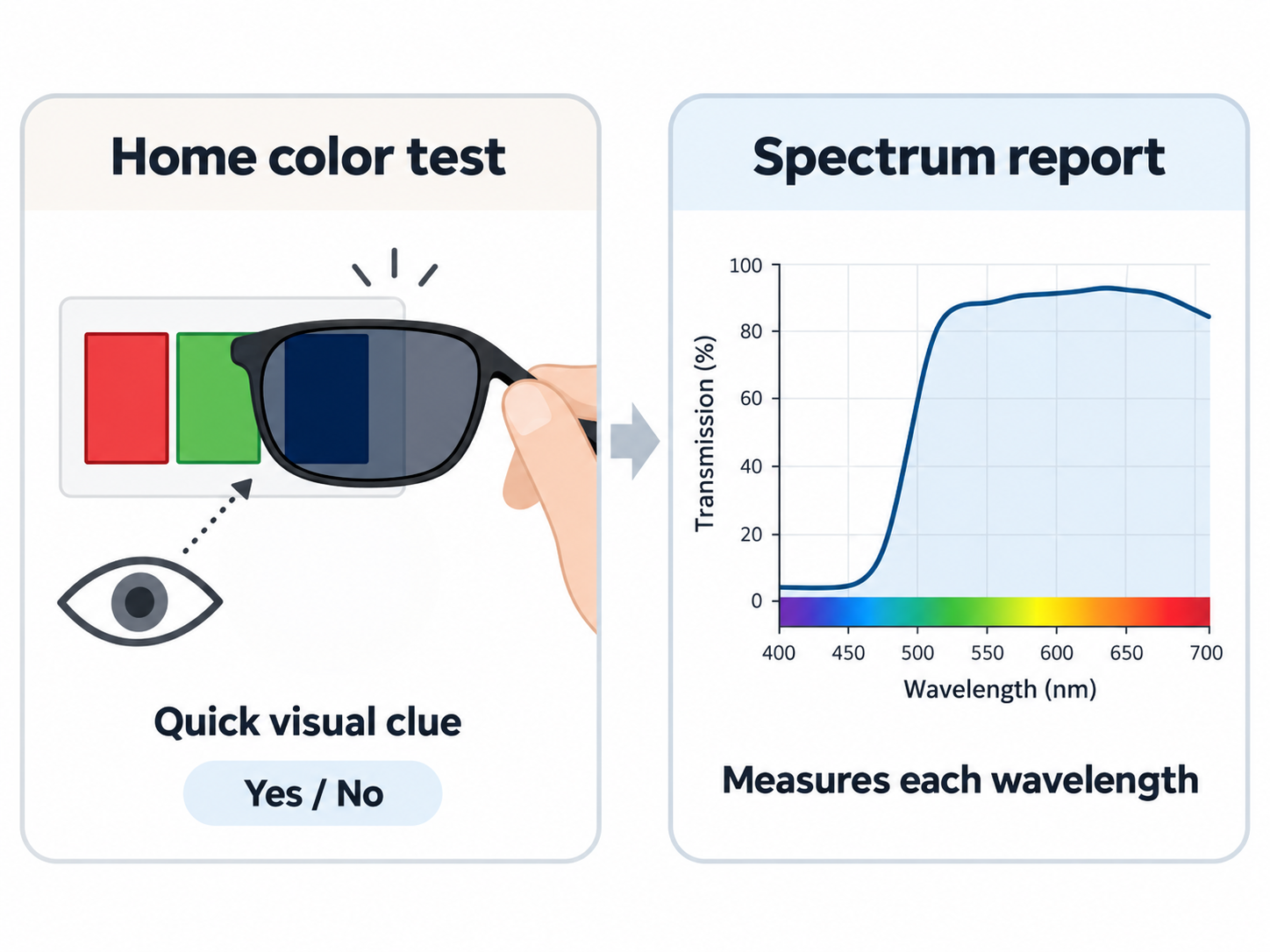
If the curve is close to zero at a wavelength, very little of that light passes through. If it is close to 100 percent, most of that light passes through.
The shape of the curve matters more than a vague claim on a product page.
Before choosing a test, check the lens type. Clear daytime lenses may create only a subtle change. Amber, orange, and red nighttime lenses should create a much stronger visual difference. A test designed for a dark red lens may be too insensitive to tell you much about a nearly clear lens.
Test 1: What does the white-background test show?
Open a plain white page on a computer or place the glasses over white paper in neutral light.
Look at the white area without the lens. Then look through the lens.
A clear lens may show little change. A yellow or amber lens will make the white area look warmer. An orange or red lens may create a strong color shift.
This is a useful first check because it shows that the lens changes the balance of visible light. A stronger warm tint usually creates a more obvious reduction in short-wavelength light.
But the test has limits. Your eyes adapt quickly to color. The room light and screen settings also affect what you see. A strong tint does not reveal an exact blocking percentage.
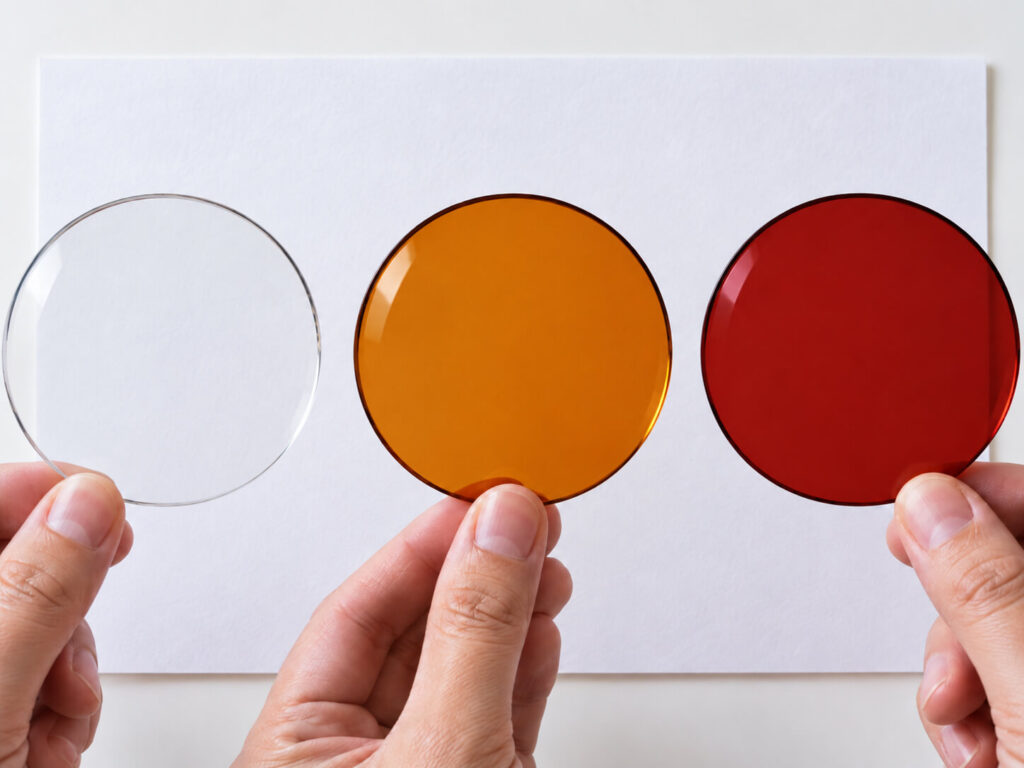
What this test can show: Whether the lens creates a visible warm color shift.
What it cannot show: Which exact wavelengths are reduced or by how much.
Test 2: Can lens reflections prove blue light filtering?
Hold the glasses under a lamp. Tilt them and look at the reflection on the front surface.
Some clear blue-light lenses show a blue, purple, or violet reflection. This may come from a reflective coating. Other lenses reduce short-wavelength light by absorption inside the lens material. Their reflections may look different.
The reflection test can tell you that a coating is present. It cannot tell you how much blue light reaches your eyes.
A strong blue reflection is not the same as a strong blue-light-blocking result. A normal anti-reflective coating may also create colored reflections. The color can change with viewing angle and room lighting.
Treat the reflection test as a coating check, not a performance measurement.
Test 3: How does an RGB screen test work?
An RGB test image contains red, green, and blue areas. A digital screen creates these colors with red, green, and blue subpixels.
You can use the interactive RGB color chart from BioHackers Lab for this check. First, view the chart without glasses. Notice the blue outer ring and lighter center. Then put on the glasses and view the same image at the same screen brightness.
Strong amber, orange, or red lenses should make the blue area look darker. They may also change cyan or green, depending on the lens. Clear lenses may create a much smaller difference.
The red area often changes less. This makes the test useful for comparing how strongly a lens changes different parts of the visible spectrum.
You can also hold one lens in front of the screen and leave the other half uncovered. This gives you a direct side-by-side comparison.
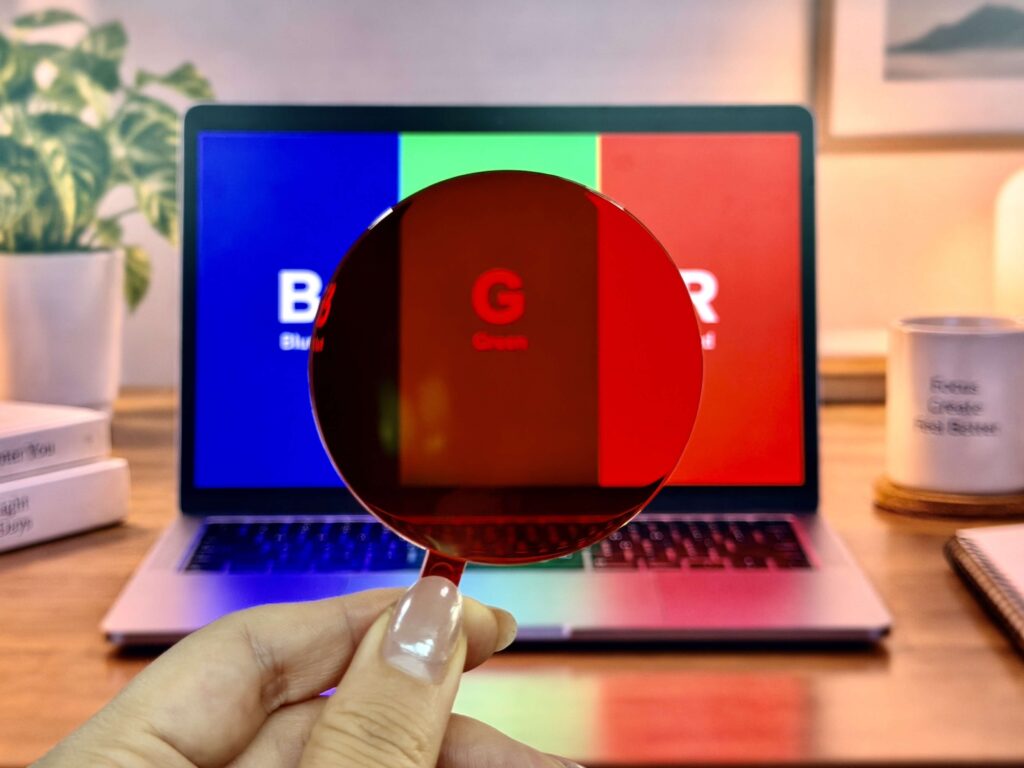
BioHackers Lab describes disappearing blue or cyan areas as a sign of strong visible filtering. That is useful as a visual demonstration. It is not a precise measurement. Screen output varies by device. Brightness settings, display calibration, ambient light, color vision, and viewing angle can all change the result.
The test is also less useful for nearly clear lenses. A clear filter may produce a real but subtle spectral change that is hard to see by eye.
What this test can show: A visible difference between red, green, and blue screen output.
What it cannot show: A reliable wavelength range or laboratory-grade blocking ratio.
Test 4: How does a flashing blue-and-black test work?
The IrisTech blue light filter test provides animations that switch between blue and black. It also includes a blue-green and black version.
Open the animation and set a comfortable screen brightness. View it without the glasses first. Then repeat the test through the lens. Do not stare at a bright, flashing screen in a dark room for a long time.
If the lens strongly reduces the screen’s blue output, the blue phase may look much darker. With a very strong filter, the switch between blue and black may become hard to see. The blue-green animation can show whether the lens also makes that mixed color harder to distinguish from black.
This result needs careful wording. If the image appears black through the lens, it means you cannot see a clear difference under that particular setup. It does not prove an exact 100 percent blocking rate across the whole blue or green spectrum.
The test checks the output of one display. A computer screen does not emit every wavelength in the blue range. It has its own spectral peaks. A lens can look effective against one display while behaving differently under another light source.
Flashing color tests make strong filtering easy to see. They do not replace a full spectrum report.
Test 5: Is the blue-light pen test reliable?
Some glasses come with a blue or violet LED pen and a small test card. You shine the light on the card with and without the lens in front of it.
If the mark becomes dimmer, the lens reduces light from that pen. That is all the test proves.
The pen may emit mainly violet or near-ultraviolet light. Your screen may peak at a different wavelength. A lens can perform well in the pen test but reduce much less of the blue light produced by a phone or monitor.
The card can also make the result look dramatic because it reacts to a limited part of the spectrum.
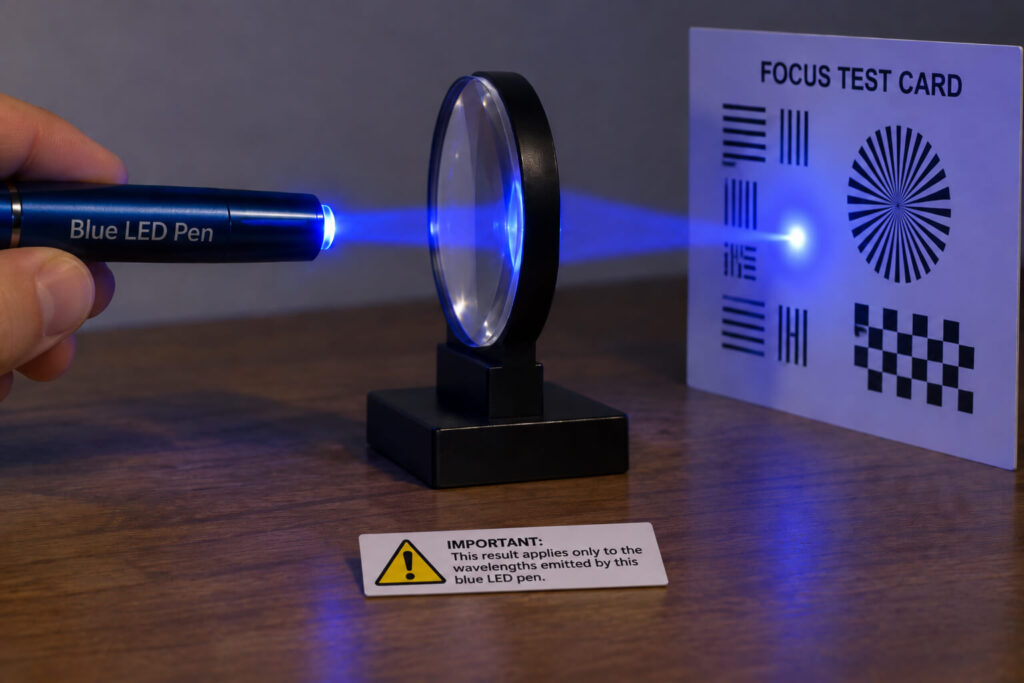
Use the pen to compare lenses under the same conditions. Do not use it to confirm a broad “blocks 100 percent of blue light” claim.
What this test can show: Whether the lens reduces the specific light emitted by the pen.
What it cannot show: Performance across the full blue-light range.
Which blue light glasses test is the most accurate?
A spectrophotometer test is the most accurate option.
The instrument sends controlled light through a lens. It measures how much light passes through at many wavelengths. The result is a spectral transmittance curve.
Published lens studies use this method to compare products. For example, one study measured commercial lenses from 300 to 780 nanometers in five-nanometer steps (full study).
Gloojo also shows this type of data in its article on spectral testing of red and orange sleep glasses. The useful part is not the color of the lens by itself. It is the measured transmission curve behind the lens.
When a brand provides a report, check for these details:
A wavelength scale, usually shown in nanometers
A transmission scale shown as a percentage
The name or code of the tested lens
A clear test range
A curve that can be read at individual wavelengths
Information about the test equipment or method
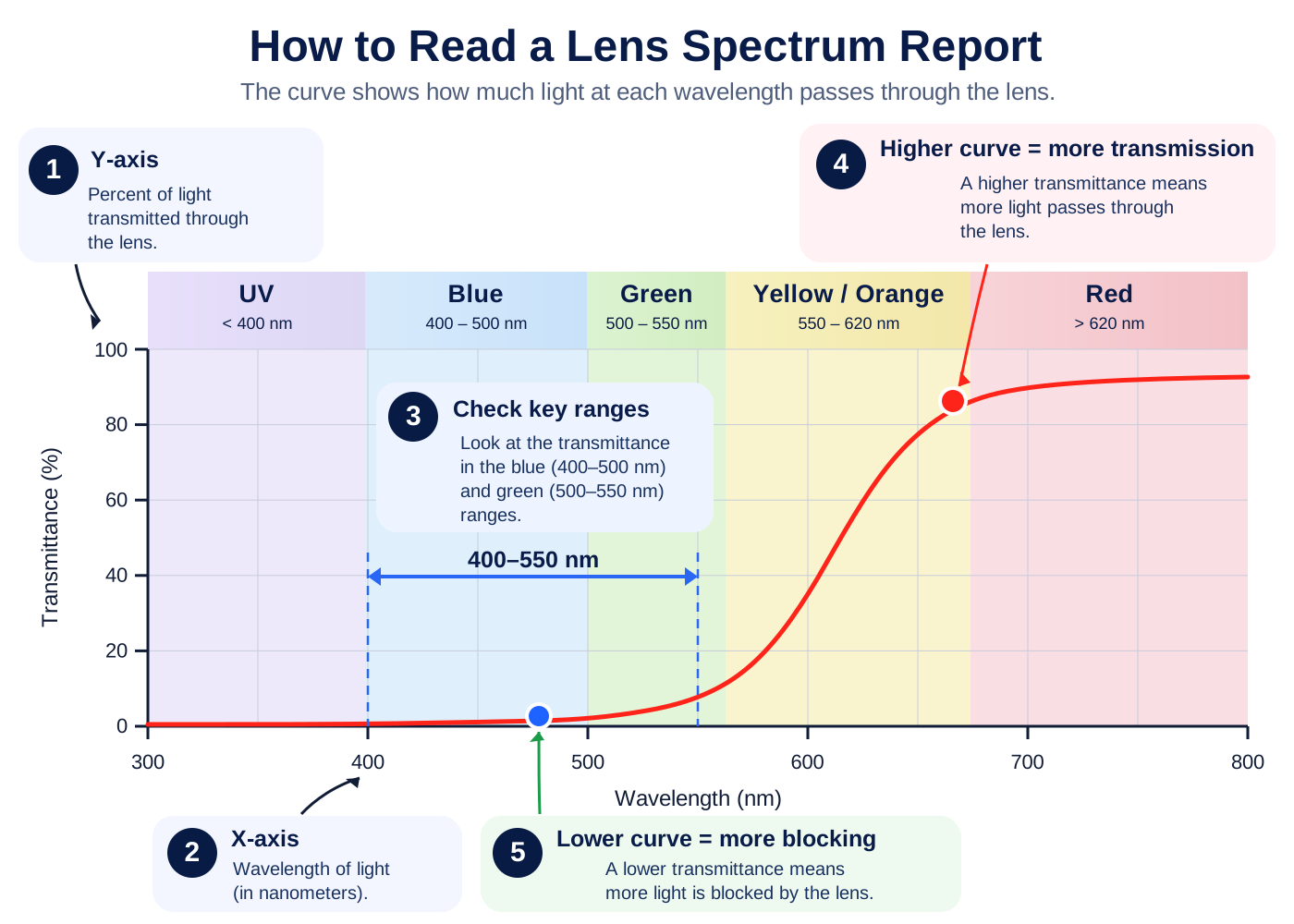
A report for one tint does not automatically apply to every lens sold by the same brand. Check that the frame and lens option match the product you want to buy.
Can a home test tell you whether the glasses will improve sleep?
No. A home test only checks visible filtering behavior.
It does not test your sleep. It cannot measure melatonin, sleep onset, total sleep time, or how rested you feel the next day.
Clinical evidence on blue-light-filtering glasses and sleep remains mixed. A 2023 Cochrane review examined 17 randomized trials. Six trials reported sleep outcomes. Three found improvement, while three found no difference. The reviewers described the evidence for sleep quality as uncertain.
The same review found that blue-light-filtering lenses may not reduce short-term digital eye-strain symptoms compared with non-filtering lenses.
This does not mean every lens is identical. It means a successful color test should not be turned into a health promise.
Does a blue light test prove that screens damage your eyes?
No.
The term “blue light hazard” has a specific technical meaning. It refers to the risk of photochemical retinal injury under particular exposure conditions. It should not be used as a general label for normal screen light.
The International Commission on Illumination has warned against using “blue light hazard” loosely when discussing ordinary lighting and screens.
A lens test shows how the lens changes light. It does not prove that the original light source was harmful.
If your eyes feel dry or tired during screen use, other factors may matter. These include long periods of close focus, reduced blinking, glare, dry air, and an outdated prescription.
Popular blue light glasses tests vs. what they prove
| Test | What You May See | What It Can Tell You | Main Limitation |
|---|---|---|---|
| White paper or white screen | A warmer color through the lens | The lens changes visible color balance | No wavelength or percentage data |
| Lens reflection | Blue, purple, green, or violet glare | A surface coating may be present | Reflection color does not equal blocking strength |
| RGB chart | Blue, cyan, or green areas become darker | Useful qualitative color comparison | Depends on the screen and your vision |
| Flashing blue-and-black test | The color change becomes less visible | Shows strong filtering of that display’s output | Cannot prove an exact percentage or full spectral range |
| LED pen and card | The light spot or card reaction weakens | The lens reduces the pen’s emitted light | Pen wavelength may not match screen light |
| Spectrophotometer | A wavelength-by-wavelength curve | The most useful measurement of lens transmission | Requires proper equipment and a matching lens sample |
How can you avoid a misleading result?
Start with a consistent setup. Turn off any automatic color-temperature feature on the screen unless you are testing that software. Keep brightness fixed. Use the same screen, image, room light, and viewing angle for every lens.
Run the test once without the glasses. Then hold one lens in front of only part of the image. This lets you compare filtered and unfiltered areas in the same glance. Repeat the test with the other lens if you want to check for differences between the left and right sides.
Use the same light source when comparing two pairs. A result from one phone should not be compared directly with a result from a different monitor.
Do not compare photos taken with different camera settings. Phones automatically change exposure and white balance. This can make one lens look stronger than it is.
Do not assume that a darker lens is always better. A very dark or strongly colored lens may be unsuitable for tasks that require accurate color vision. It may also reduce overall visibility.
Never wear dark red or orange sleep glasses while driving unless they are specifically approved and suitable for that use. Color changes and lower transmission can affect visual information.
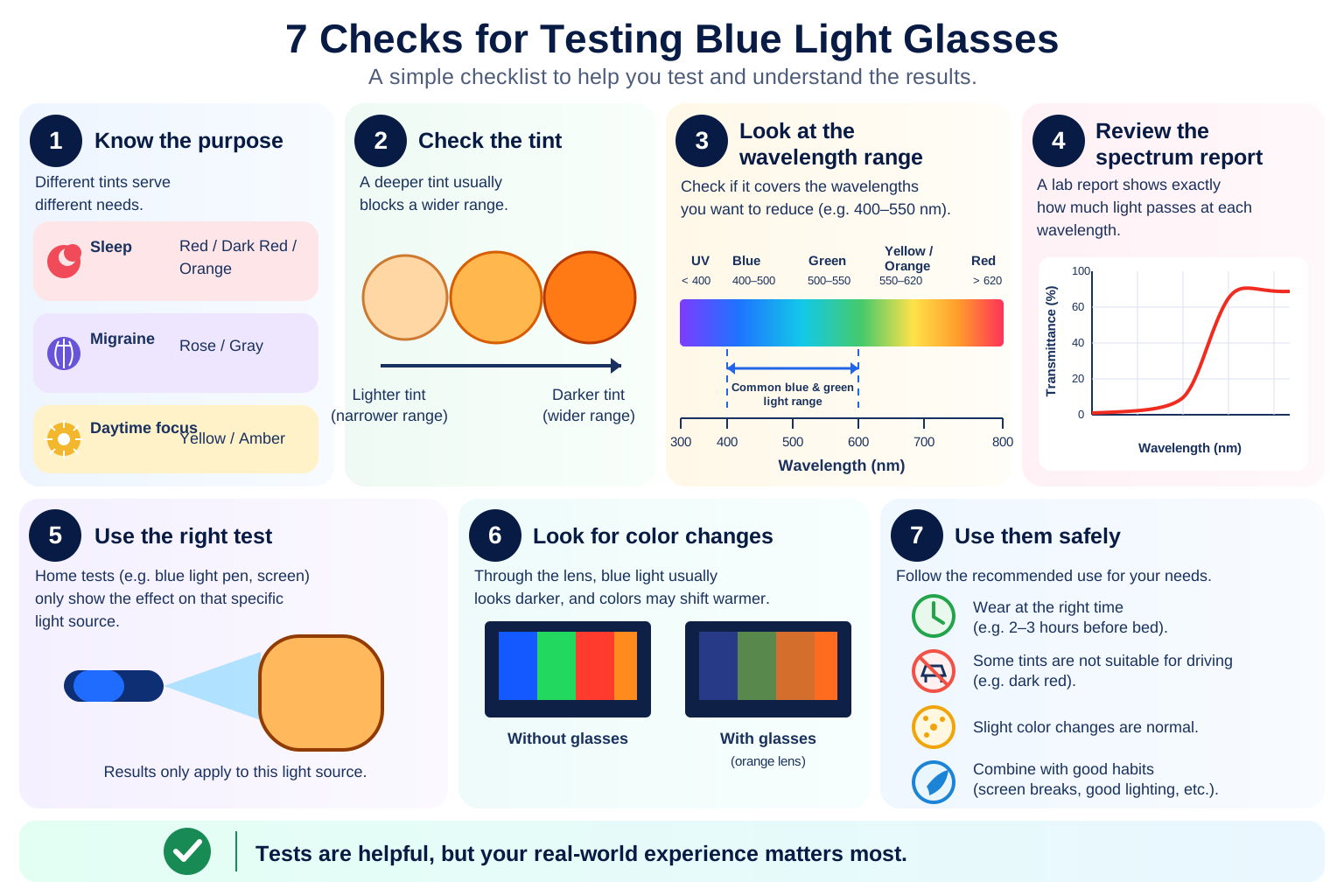
What should you ask before buying blue light glasses?
Start with the intended use.
Are the glasses for daytime screen work? Evening indoor light? Light sensitivity? A pre-sleep routine? Different goals may require different lens designs.
Then ask specific questions:
What wavelengths does the lens reduce?
How much light passes through at key wavelengths?
Is there a spectral transmittance report?
Does the report match this exact tint?
How much does the lens change color perception?
Is the lens appropriate for driving or only for indoor use?
What is the return policy if the tint is uncomfortable?
A precise answer is more useful than “blocks harmful blue light.”
How should you test blue light glasses at home?
Use home tests as a simple sequence.
First, look through the lens at a white background. Notice the color shift. Next, open the BioHackers Lab RGB chart and compare the colored areas. Then try the IrisTech flashing test to see whether the blue-to-black or blue-green-to-black change becomes less visible.
If the glasses include a test pen, remember that it tests only the pen’s light. Do not turn that result into a claim about the full spectrum.
Finally, ask for the spectral report. It is the best way to check whether the measured lens performance matches the product description.
The most honest answer is simple: your eyes can show you that a lens changes light. A spectrophotometer can show you exactly how.
Disclaimer
This article provides general educational information. It does not replace advice from an eye-care or healthcare professional.