Use the promo code to enjoy a 10% discount storewide.
Why Green Light May Be Better for Light Sensitivity

Quick Summary
- Migraine light sensitivity is not always about blocking more light.
- Some green wavelengths may feel less aggravating for migraine-sensitive eyes.
- Gray Relief reduces harsh brightness while allowing meaningful green light through.
- Its light gray tint keeps vision more natural than strong colored lenses.
- It is designed for everyday spaces like offices, screens, stores, and airports.
- Gray Relief is eyewear for visual comfort, not a migraine treatment.
If you are sensitive to light, the first instinct is usually simple: make things darker.
Close the curtains. Dim the screen. Put on sunglasses. Avoid the brightest room.
That can help in the moment.
But many people with migraine-related light sensitivity quickly run into a problem: life cannot happen in a dark room. You still need to work, shop, study, travel, look at screens, sit under indoor lights, and move through everyday spaces.
So the real question becomes more specific.
Not “How do I block all light?”
But “How do I reduce the light that feels harsh while still keeping the light that feels comfortable enough to live with?”
That is why more people are becoming interested in light sensitivity glasses that allow green wavelengths through.
Why Blocking Everything Is Not Always the Best Answer

Migraine light sensitivity, also called photophobia, is very common. The American Migraine Foundation notes that about 85% to 90% of people with migraine experience sensitivity to light.
For some people, bright light can make an active migraine feel worse. For others, screens, fluorescent lights, cool LEDs, white walls, reflective floors, or busy visual environments can feel uncomfortable even between attacks.
It is natural to reach for dark sunglasses.
But dark sunglasses are not always practical indoors. They can make the room too dim, change contrast, and make it harder to see clearly. For everyday use, many light-sensitive people want something more balanced.
They want less glare.
They want less harsh brightness.
They want less blue-rich stimulation.
But they do not want to feel like they are hiding behind dark outdoor sunglasses all day.
That is where lens design starts to matter.
The Better Question: Which Light Gets Through?

Light is not one thing.
It is made of different wavelengths. Some wavelengths may feel harsher to migraine-sensitive people, while others may be easier to tolerate.
That is why two rooms with the same brightness can feel completely different.
A warm lamp may feel calmer than a cold LED panel. A soft window-lit room may feel easier than a fluorescent office. A screen in a dim room may feel sharper than paper under natural light.
The difference is not only brightness. It is the mix of wavelengths, glare, contrast, flicker, and how your nervous system responds.
For migraine-related light sensitivity, a good lens should not simply make the world dark.
It should help shape the light that reaches your eyes.
Why Green Light Became Important in Migraine Research

This is where green light enters the conversation.
Researchers studying migraine photophobia found that different colors of light do not affect migraine-sensitive people in the same way. In one well-known study, white, blue, amber, and red light tended to intensify headache more, while green light worsened headache significantly less for many participants.
The same study also found that green light produced smaller responses in retinal, thalamic, and cortical pathways compared with several other colors.
That matters because it suggests something very useful:
Migraine-sensitive eyes may not need total darkness. They may need a better light balance.
Green light research does not mean any green bulb, green lens, or green-looking product will help everyone. The most discussed studies used controlled narrow-band green light, often around the middle visible spectrum.
But the consumer takeaway is clear: if some green wavelengths are easier for many migraine-sensitive people to tolerate, then it makes sense to ask whether light sensitivity glasses are allowing enough of that range through.
What “Allows Green Light Through” Actually Means

A lens that allows green light through does not create green light.
It simply lets part of the green range pass through the lens instead of blocking it heavily.
That distinction is important.
A green-light therapy device emits controlled green light. Gray Relief does not do that. Gray Relief is eyewear. Its job is to filter the light already in your environment.
So the question is not whether Gray Relief “produces” green light.
The question is whether it reduces harsh light while still allowing a meaningful amount of mid-spectrum green light to pass through.
For people with light sensitivity, that can be a smarter balance than simply blocking everything.
How Gray Relief Handles the Green Range
Gray Relief is designed for migraine-related light sensitivity and harsh indoor light.
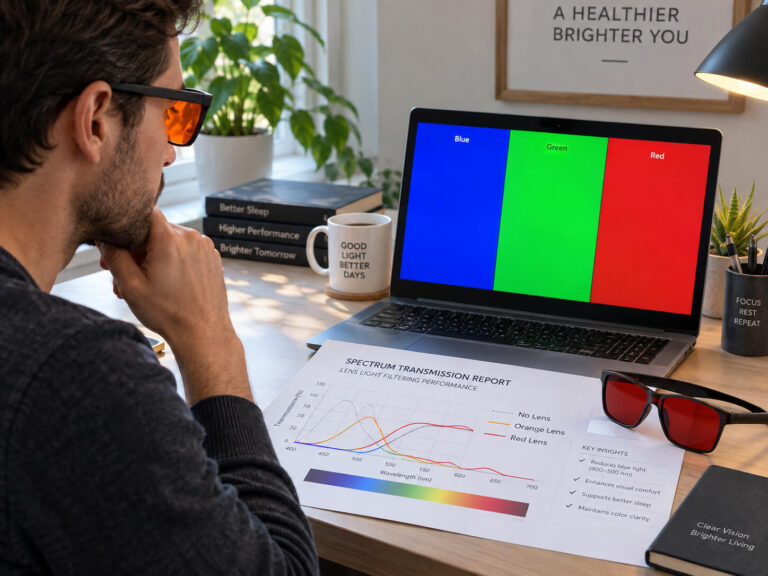
According to the Gray Relief light gray lens spectrum report, the lens has about 38% visible light transmission and 62.54% blue-light absorption. In the green range, the report shows that Gray Relief allows a meaningful amount of light through:

This is the key point.
Gray Relief does not block the green range aggressively. Around the wavelengths often discussed in green light research, it allows roughly half of that light through.
At the same time, it reduces overall brightness and helps soften blue-rich light.
That balance is why Gray Relief can feel useful for daily light sensitivity: it is not trying to turn the world dark, and it is not trying to flood your vision with color. It is designed to make harsh light feel calmer while keeping the view usable.
Why This Can Feel More Comfortable Than Ordinary Sunglasses

Ordinary sunglasses usually reduce overall brightness.
That can be helpful outdoors, but indoors they may feel too dark or socially awkward. They also may not be designed around migraine-related light sensitivity.
Gray Relief is different because it is made for everyday indoor and screen-heavy environments.
The lens softens the visual field, but it still looks more natural than many strong colored tints. That matters because comfort is not only about what the lens does optically. It is also about whether you can actually wear it.
If a pair of glasses makes your world too dark, you may take it off.
If it changes color too strongly, you may avoid wearing it at work.
If it looks too much like outdoor sunglasses, you may not want to use it in stores, offices, clinics, or classrooms.
Gray Relief is designed for the person who wants relief from harsh light but still wants to function normally.
Why Green-Passing Lenses Make Sense for Light Sensitivity
For migraine-related light sensitivity, the goal is often balance.
You want to reduce the wavelengths and intensity that feel harsh, especially in bright indoor spaces, but still preserve enough comfortable light to see naturally.
That is why allowing green light through can matter.
Research suggests that green light may be less aggravating for many people with migraine than several other colors. If a lens heavily blocks that middle green range, it may reduce useful comfortable light along with the harsh light.
Gray Relief takes a more practical approach.
It helps reduce overall brightness and blue-light exposure while still allowing a meaningful amount of green-range light to pass through.
That makes it easier to understand why the lens can feel calmer without feeling overly colored.
Gray Relief vs. Strong Colored Tints
Some migraine glasses use rose, pink, orange, yellow, or other stronger tints.
Those can be helpful for many people. Gloojo Rose Relief™ is the classic rose-tint option for migraine-related light sensitivity.
But not everyone wants a strong color shift.
Some people want a lens they can wear more naturally in daily settings. They want the visual comfort of a light sensitivity lens without the feeling that everything has turned pink, orange, or yellow.
Gray Relief is for that customer.
It is the more natural-looking option within Gloojo Anti-Migraine Glasses. It is designed for people who want daily light comfort with less obvious color change.
It still softens harsh light.
It still reduces blue-rich exposure.
It still allows a meaningful amount of green-range light through.
But it does all of that in a gray lens that feels easier to wear in real life.
When Gray Relief Makes the Most Sense

Gray Relief is especially useful if your light sensitivity shows up in everyday environments, such as:
- fluorescent lights
- cool LED lighting
- computer screens
- bright stores
- offices
- classrooms
- clinics and waiting rooms
- airports
- indoor glare
- visually busy spaces
These are places where clear glasses may not do enough, but dark sunglasses may feel like too much.
Gray Relief is designed for that middle space.
It gives sensitive eyes a calmer visual environment while preserving a more natural-looking view.
What Gray Relief Is Not

Gray Relief is not a medical treatment for migraine.
It does not cure migraine, prevent migraine attacks, or replace medical care.
It is also not a green light therapy device.
It does not create narrow-band green light.
What it does is more practical: it helps filter everyday light in a way that reduces harshness, supports visual comfort, and still allows a meaningful amount of the green range to pass through.
For many consumers, that is exactly the kind of light sensitivity eyewear they are looking for.
The Takeaway
If you are shopping for migraine light sensitivity glasses, the goal should not always be to block as much light as possible.
A lens that is too dark can be hard to wear indoors. A lens that changes color too strongly can be hard to use in daily life. A lens that blocks the wrong parts of the spectrum may not feel as comfortable as expected.
Green light research gives us a better way to think about this.
For many migraine-sensitive people, some middle green wavelengths may be easier to tolerate than harsher blue-rich or high-glare light. That is why consumers are becoming more interested in glasses that allow green light through while still softening the light environment.
Gray Relief is built for that need.
It reduces overall brightness, helps soften blue-rich light, allows a meaningful amount of green-range light to pass through, and keeps the view more natural than many stronger colored lenses.
If you want light sensitivity glasses that feel easier to wear in real life, Gray Relief is a strong place to start.
Disclaimer
This article is for educational purposes only and is not medical advice. Gloojo Migraine Relief Glasses are not intended to diagnose, treat, cure, or prevent migraines, chronic headaches, photophobia, or any underlying medical condition. If you experience severe, frequent, or worsening headaches, take prescription medications, are pregnant or nursing, or are managing a neurological condition, please consult a qualified healthcare professional.
References
American Migraine Foundation: Photophobia and Migraine: Source
Noseda et al., Migraine Photophobia Originating in Cone-Driven Retinal Pathways: Source
Martin et al., Evaluation of Green Light Exposure on Headache Frequency and Quality of Life in Migraine Patients: Source
Noseda et al., Current Understanding of Photophobia, Visual Networks and Headaches: Source