
Use the promo code to enjoy a 10% discount storewide.
Migraine Event Plan: Travel, Weddings, and Multi-Day Events

A migraine event plan is a set of choices you make before a trip, wedding, conference, reunion, or other time-bound commitment. It identifies the moments that matter most, what you can skip, where you can rest, who needs to know, and when you will leave. The goal is not to guarantee a symptom-free event. It is to keep participation adjustable if your capacity changes.
That distinction matters because attendance does not have to mean being present for every hour. You can arrive late, step away, rejoin, shorten a day, or leave early and still take part in something important.
Start with your minimum meaningful participation
Before you plan the full event, define the smallest version that would still feel worthwhile. Your minimum meaningful participation is the one moment, connection, or responsibility you most want to preserve if you cannot do everything.
For a wedding, it might be the ceremony and a quiet conversation with the couple—not the entire reception. On a trip, it might be one family activity rather than every stop on the itinerary. At a three-day conference, it might be a particular session and one scheduled meeting.
Use three lists:
Priority: the moments you most want to attend.
Optional: activities you can decide on that day.
First to release: commitments you will skip if capacity is limited.
Make the priority list short. If everything is essential, the plan gives you no room to adjust.
Migraine symptoms and phases can vary between people and between attacks. A flexible plan does not predict exactly what will happen; it gives you usable choices if the day differs from what you hoped.
Build the migraine event plan before you go
The best time to make tradeoffs is when you are not standing in a noisy venue or trying to renegotiate plans while feeling unwell.
Create slack around the priority moment
Avoid placing every demanding activity back to back. If the ceremony is your priority, for example, the optional welcome drinks the night before may be the first thing you release. If a conference presentation matters most, consider whether the dinner afterward should remain tentative.
For travel, look at the whole journey rather than only the event itself. Departure time, connections, ground transportation, check-in, and the first scheduled activity all draw from the same practical margin. A later arrival or an unscheduled first evening may preserve more options than a tightly packed itinerary.
Protect your established routine without inventing a new one
Bring what you normally use under your established care plan and keep familiar food, hydration, medication, and sleep routines as workable as the trip permits. This is not the moment to create a new regimen or change medication based on a general checklist.
If you track patterns, use what you already know about your own experience. The American Migraine Foundation notes that trigger attribution can be complicated: exposures may be inconsistent, combine with other factors, or be confused with early symptoms. Build around your patterns rather than somebody else’s universal “avoid” list.
Identify a real place to pause
“Take a break if needed” is too vague. Name the place in advance:
a hotel room near the venue;
a quiet guest room or lobby corner;
your parked rideshare pickup point;
an outdoor or low-stimulation area that you have already located;
a place where you can sit without having to explain yourself.
A rest window supports participation; it is not a promise that symptoms will resolve. Decide whether the break is a short reset before reassessing or the beginning of your departure.
Make leaving logistically possible
An intention to leave early is useful only if you can act on it. Before the event, answer:
Threshold: What specific change means you will stop or leave?
Transport: How will you get back without depending on someone who plans to stay?
Check-in: Who will you tell, and how will they know you arrived where you intended to go?
Possible thresholds might include being unable to follow a conversation, noticing that your established symptoms are escalating despite a planned break, or reaching a time limit you chose earlier. Use thresholds that fit your own known pattern and care plan; do not wait for the situation to become unbearable just to prove that you tried.
Tell one person before the event
You do not need to explain migraine to the entire guest list. Choose one point person—a partner, friend, relative, colleague, or event contact—who can help protect the plan from social pressure and practical confusion.
Share four things:
the moment you hope to attend;
what you may skip;
where you will go for a break;
what help, if any, you want when you decide to leave.
Simple scripts for changing the plan
Keep the language brief enough to use when you have limited energy.
Before the event:
“I’m planning to be there for the ceremony. I may skip part of the reception or leave early, so please don’t hold anything for me.”
For a late arrival:
“I’m adjusting my timing today. I expect to join at 3:00, but I’ll update you if that changes.”
For a break:
“I’m going somewhere quiet for a while. I don’t need you to fix anything; I’ll text when I know whether I’m rejoining.”
For an early departure:
“I’m glad I came, and I’m leaving now as planned. I’ll message you when I’m back.”
For a companion who wants to help:
“If I say I’m done, please help me leave rather than asking me to reconsider.”
These scripts communicate the decision without inviting a debate. If someone needs more context, you can explain at another time—not in the middle of the event.
Use the plan in the moment: reduce, reset, reassess, or leave
When your capacity changes, use a simple sequence instead of deciding the entire day again.
Reduce: Drop the next optional activity or shorten the current one.
Reset: Go to the place you identified and reduce conversation, movement, or other demands as needed.
Reassess: Ask whether returning for the priority moment is workable—not whether you can force yourself through the original schedule.
Leave: If you have reached your preset threshold, use the transport and check-in plan.
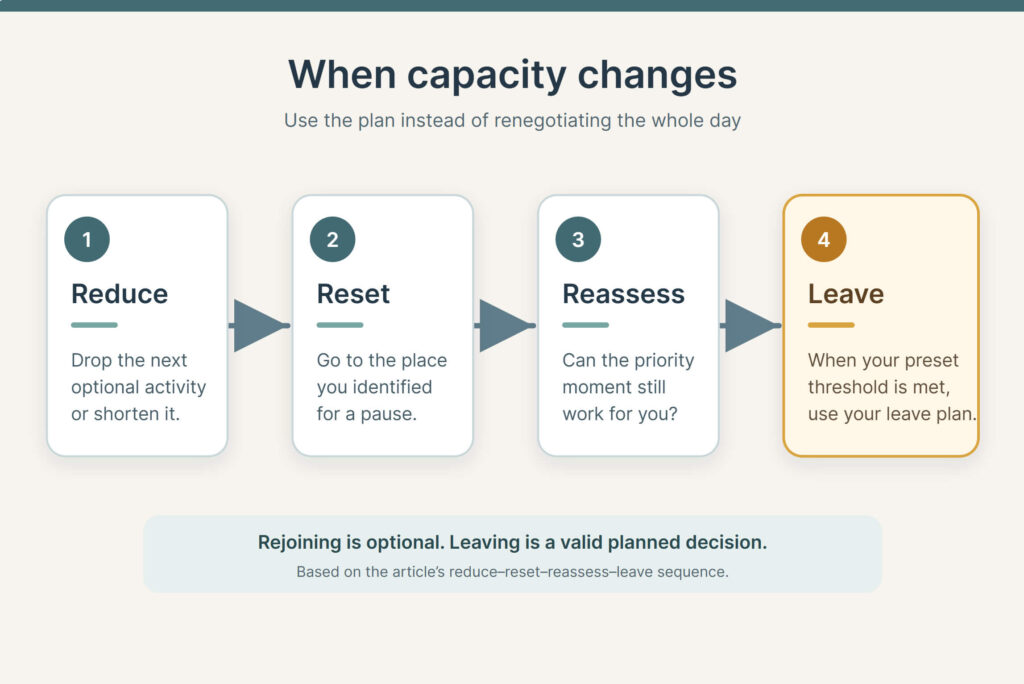
Rejoining is an option, not an obligation. So is leaving. The plan has done its job when it helps you make a clear decision with less negotiation, even if the decision is to go home.
How the tradeoffs change by context
The framework stays the same, but each setting puts pressure in a different place.
| Context | Main constraint | Protect first | Easiest place to create flexibility | Departure question |
|---|---|---|---|---|
| Travel | Transit and event demands can stack together | Arrival margin and the trip’s priority activity | Connections, first-night plans, optional outings | Can I return to the lodging independently? |
| Wedding | A few moments happen at fixed times | Ceremony, meal, toast, or personal connection—choose one or two | Getting ready, cocktail hour, dancing, or the late reception | Who needs a brief goodbye, if anyone? |
| Multi-day event | Demands accumulate across days | The highest-value session or connection each day | Morning starts, evening socials, lower-priority sessions | Am I ending one day early enough to preserve tomorrow’s choice? |
Travel with migraine: plan the edges of the trip
Many lists of migraine travel tips focus on what to pack. Packing matters, but participation also depends on timing and escape routes. When considering how to travel with migraines, look for pressure at the edges: an early departure followed by an immediate event, a long transfer with no pause, or lodging far from the venue.
Choose which constraint to loosen. You might travel a day earlier, keep the arrival evening open, stay closer to the main event, or pre-identify transport back to your lodging. These are tradeoffs, not guarantees; use the one that protects your priority moment most directly.
Attending a wedding with migraine: separate meaning from duration
A wedding can create pressure to stay because departures are visible and the schedule feels socially fixed. Decide before you arrive what counts as meaningful participation. If that is the ceremony and a conversation with the couple, then leaving before dancing is not an incomplete version of an eight-hour plan. It is the plan you chose.
If you are wondering what to do if you get a migraine at a wedding, start with the decisions already made: tell your point person, step into the identified quiet place, reassess once, and leave when your threshold is met. Avoid making the couple or host responsible for deciding whether you should stay.
Migraine and multi-day events: plan each day, not one heroic total
At a reunion, festival, or conference, the temptation is to make one commitment for the entire event. Instead, define a priority for each day and keep at least one block optional. Review the next day only after the current one ends.
A shorter first evening, a skipped social hour, or a later morning may preserve the possibility of joining what matters most later. It may not change your symptoms; it simply prevents every activity from becoming equally non-negotiable.
Plan for bright indoor light only if it matters to you
If bright indoor lighting or photosensitivity is part of your known experience, include the light environment in the venue plan. Natural and artificial light can worsen discomfort for some people with migraine-related photophobia, but blanket darkness is not a universal solution.
Practical comfort options may include choosing a seat away from a harsh fixture, knowing where you can step out, shortening time in the brightest room, or bringing a familiar light-management option you already use. Treat these as ways to make the setting more tolerable—not as treatment, prevention, or a reason to deliberately test your limits.
If light sensitivity is new, unusual, severe, persistent, or meaningfully different from your established pattern, it deserves appropriate medical guidance rather than being treated only as an event-planning problem. Photophobia can occur in more than one neurological or eye-related context.
Decide now, so you do not have to prove anything later
Pick the one moment that makes the event meaningful to you. Then choose one thing you are willing to release, one place you can pause, and one threshold for leaving. Share that plan with one person before you go.
Success is not staying the longest. It is participating in a way that keeps your choices intact—even when the workable version of the day is smaller than the original one.
Disclaimer
This article is for educational purposes only and is not medical advice. Gloojo are not intended to diagnose, treat, cure, or prevent migraine, headaches, or any medical condition. If you have chronic migraine problems, take medication, are pregnant or nursing, or are considering migraine supplements, please speak with a qualified healthcare professional.