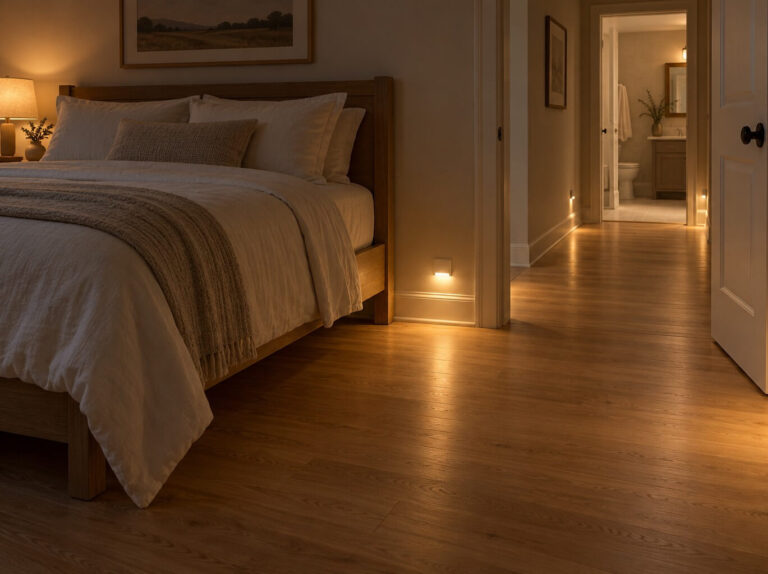




A practical light exposure schedule for sleep makes the day well lit, brings daylight into your workday when you can, and makes the evening and night quieter and dimmer. If dimming helps you feel sleepy earlier but you still wake at night, keep the useful change and look at what happens after you wake rather than simply making the evening darker.
You don’t need sunrise to fit neatly around your work hours. Nor does a regular bedtime mean you must lie awake until sleep arrives. The aim is a routine you can actually use, with enough room for sleep and a different response to each part of the night that remains difficult.
Why a schedule involves more than bedtime
Your circadian rhythm is an internal timing system that helps organize when your body is more ready for wakefulness or sleep. Light and darkness are among its cues. Sleep pressure is different: it generally builds while you’re awake and eases with sleep. The two work together, as the National Heart, Lung, and Blood Institute explains.
A steady wake time can be a useful anchor, but the same bedtime on the clock doesn’t guarantee that you’ll be sleepy when you get there. Stress and frustration can also make resting difficult. And feeling sleepy earlier tells you something about the evening; it doesn’t by itself explain or resolve what happens later in the night.
For adults with regular daytime schedules, expert recommendations on indoor light emphasize a brighter day, reduced light in the lead-up to sleep, and a dark sleep environment. Think of that as an overall contrast, not a demand to find the perfect bulb or follow a minute-by-minute formula.
An illustrative workday, from dark morning to night
Suppose your work starts at 8:00 a.m., winter sunrise is after that, and you usually wake at 6:30 a.m. The times below are planning examples, not a prescribed light dose or a universal bedtime. The 10:30 p.m.–6:30 a.m. window leaves eight hours available for sleep; your own needs may differ. Shift the whole arrangement around your actual obligations and protect enough opportunity for the sleep you need.
| When | A workable arrangement |
|---|---|
| 6:30 a.m. — wake | Get up around your usual time and turn on ordinary room lights. Add a kitchen or desk task light where you need it, so you’re not trying to start the day in a dim room while waiting for sunrise. |
| 8:00 a.m. — work begins | Keep your work area comfortably well lit. Once the sun is up, use your first feasible break to go outdoors for daylight. If the morning is packed, an outdoor lunch is a practical next opportunity; continue to use suitable indoor light in the meantime. |
| Afternoon — work and daily life | Keep the space usable and take another outdoor break if it fits. If you nap or use caffeine, notice whether either seems to affect your readiness for sleep later. |
| Around 8:30 p.m. — transition | Lower unnecessary overhead lighting and use a smaller light for what you’re doing. Make screens comfortably dimmer when practical, while keeping enough light for the task. |
| Around 10:30 p.m. — bed | Go to bed when sleepy, allowing enough time before your usual wake-up for sleep. If you’re not sleepy yet, spend some quiet time in low light and reassess rather than treating the clock as an instruction to force sleep. |
| If you wake overnight | Keep any necessary light low but sufficient to move safely. If you remain clearly awake or frustrated, leave bed for a quiet activity in low light and return when sleepy. |
If you need a longer sleep window, make room for it in your overall schedule rather than simply moving bedtime later while holding an early alarm fixed. A day’s light arrangement is a support for that opportunity, not a substitute for it.
When the sun rises after work starts
For morning light before sunrise, use the lights already available to make your indoor morning functional; then take the first daylight opportunity that your schedule permits after sunrise. You don’t have to sit in darkness until dawn, change your work start, or buy a special lamp to follow this ordinary-resource plan.
At home, switch on the main light in the room where you’re getting ready and use a task light for breakfast or reading if that makes the space more usable. At work, arrange your desk lighting for the work itself. When daylight arrives, a break outside can fit between tasks; if that’s impossible, lunch may be your first realistic chance. The point is to bring daylight into the day where it fits, not to turn a missed sunrise into a failed routine.

On a regular schedule but awake in bed for hours
If you’re regularly getting into bed at the appointed time and lying awake for an hour or two, check whether that time matches actual sleepiness—not just whether it matches your calendar. Keep a reasonably consistent wake anchor, but don’t try to solve the problem by deliberately cutting your sleep opportunity.
Notice what the evening feels like: are you struggling to stay awake, or simply going to bed because you think you should? If you are still alert, use a quiet, dimly lit space for a while before returning to bed when sleepy. Also consider whether a late nap or caffeine might be relevant to your own pattern, rather than changing everything at once.
If you’re already in bed and become clearly awake or frustrated, get up for something quiet, such as reading in a chair under a low light. Return when sleepy. There’s no need to watch the clock: the point is to step away from the effort of trying to sleep, not to meet a deadline. Repeated wakefulness and frustration in bed can sometimes strengthen an association between bed and alertness; behavioral sleep treatment uses this distinction to help rebuild the bed–sleep connection.

If difficulty persists, especially when it affects your days, discuss the pattern and your sleep opportunity with a healthcare professional. Cognitive behavioral therapy for insomnia (CBT-I) is an evidence-based option for adults with persistent insomnia; it is more than a list of general sleep habits.
Sleepier earlier after dimming, but still waking at night
Earlier sleepiness is worth noticing. Keep the evening arrangement if it works for you, then look separately at falling asleep, waking during the night, and how long you remain awake afterward. An earlier sleepy feeling and uninterrupted sleep are different observations.
Check for a practical disruption you can address: light entering the bedroom, a noise that wakes you, discomfort, or a habit such as reaching for a bright screen. Make the bedroom dark and comfortable for sleep, and arrange a small, accessible light for necessary nighttime trips. If you can’t fall back asleep after waking at night and feel increasingly alert, use the same quiet, low-light break away from bed, returning when sleepy. You don’t have to make every awakening a project; the alternative is there for the wakeful stretches that become difficult.
The same distinction helps in the evening. You might dim the room but still need to read, finish something on a screen, or share lighting with someone else. For that situation, Gloojo Night Ease orange-tint glasses are an optional way to filter short-wavelength light while keeping more visible light than the red tint for evening activities. Their suggested wear window is two to three hours before bed. They can be one part of an evening arrangement when you can’t change every light source around you.
See which part of the plan is helping
For several ordinary days, make a rough note of the change you made, when sleepiness showed up in the evening, your estimate of time awake before sleep, any prolonged wakefulness overnight, and how you felt the next day. You can do this in the morning without checking the clock during the night.
Look for a pattern rather than judging the plan by one night. If evenings feel easier but nights are still interrupted, that is useful information: keep the evening change and focus your next adjustment—or your conversation with a healthcare professional—on the remaining difficulty.
Disclaimer
This article is for educational purposes only and is not medical advice. Gloojo Night Ease™ Sleep Glasses are not intended to diagnose, treat, cure, or prevent insomnia, sleep disorders, circadian rhythm disorders, or any medical condition. If you have chronic sleep problems, take medication, are pregnant or nursing, or are considering sleep supplements, please speak with a qualified healthcare professional.