Use the promo code to enjoy a 10% discount storewide.
Screen Light Before Bed: A Practical Fit Guide
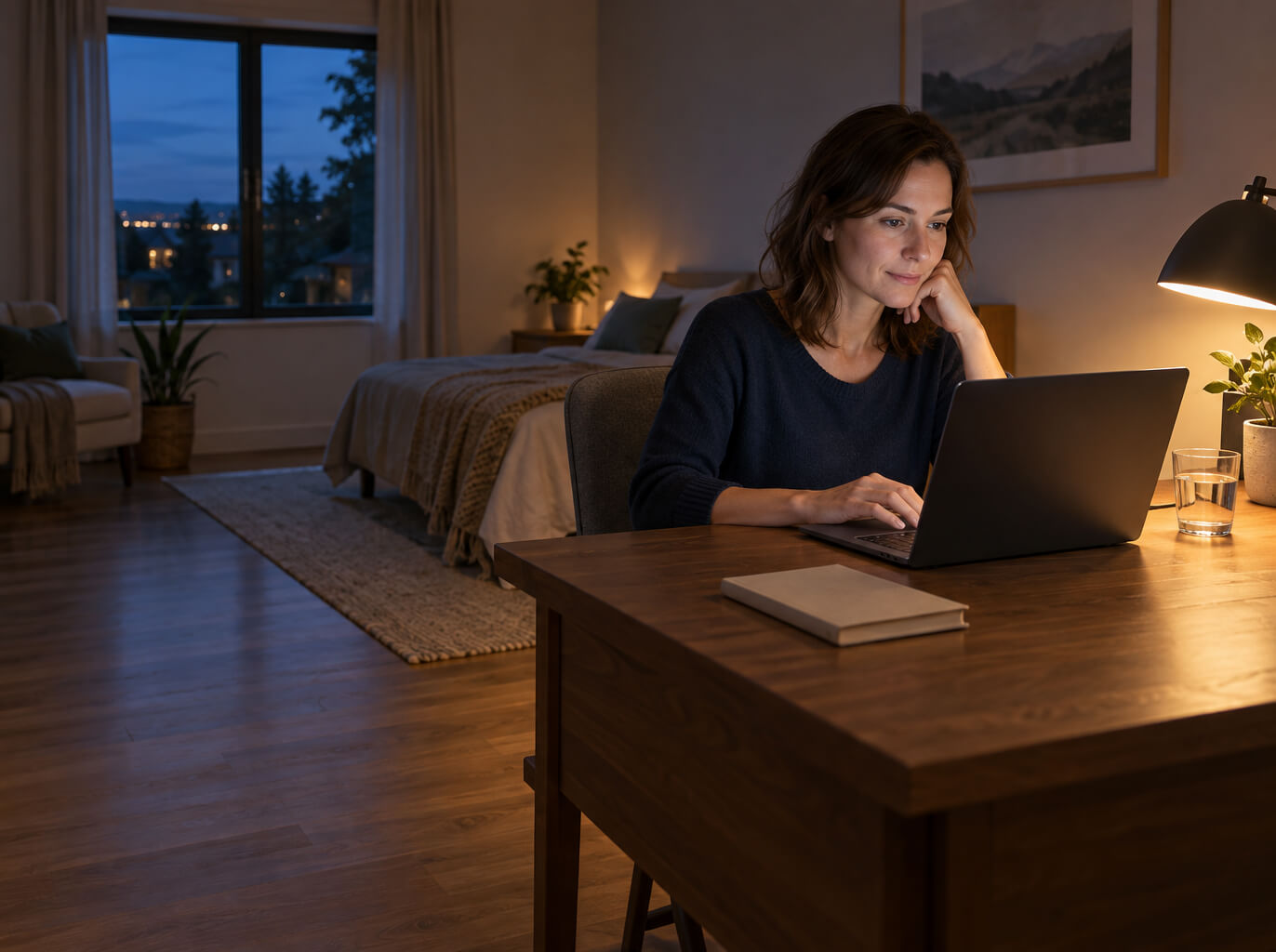
You do not have to make your evening unusable to manage screen light before bed. The practical goal is to match the amount of light control to what you still need to see and do: modest controls for active household time, stronger controls for seated work or reading, and strict controls only when you can remain safely stationary.
That makes bedtime light a fit problem, not a willpower test. Start with the least restrictive setup that meets your goal, then strengthen it only where the tradeoff in readability, color, movement, or safety still makes sense.
Start with two questions, not one rule
Visibility need means how accurately and freely you must see: reading small text, recognizing colors, moving through a room, checking on a child, preparing medication, or driving all demand different levels of vision.
Light-control level means how much you want to reduce or reshape evening light. It can range from lowering glare and brightness to combining several room and screen changes, or using a very restrictive setup shortly before sleep.
Before choosing a strategy, ask:
What will I still be doing? A seated reader has different needs from someone cooking, providing care, walking stairs, or traveling home.
How much control do I actually need tonight? A long work session may call for a different compromise than 15 minutes of low-stakes reading.
Evening light is one input to circadian timing, not a single on/off switch. The International Commission on Illumination recommends considering the amount, spectrum, duration, and timing of light. Prior light exposure and the rest of your daily pattern matter too, and controlled research also shows substantial person-to-person variation in evening-light response.
Three terms are easy to blur together:
Visible brightness is how bright something looks. Lowering it can reduce the total light reaching your eyes, but a display that is too dim for its surroundings may become hard to read.
Warmth describes color appearance. A warmer setting changes the spectrum, but “looks orange” does not tell you the complete circadian effect.
Circadian effect depends on the spectrum and amount of light reaching the eyes, plus timing and duration. It cannot be inferred from color appearance alone.
In other words, a warmer screen is not automatically a dim screen, and a dim-looking red lamp is not automatically equivalent to a carefully measured low-circadian-light environment.
Color appearance is only one part of an evening-light setup.
Use the visibility-versus-control fit table
Choose by the task you will perform after the change—not by which option sounds strictest.
| Strategy | Light-control level | Good fit when | Poor fit when |
|---|---|---|---|
| Lower room brightness and reduce glare | Modest | You are moving around, doing chores, or sharing a room and need normal orientation | You keep bright overhead fixtures or strong reflections in view, or need tighter control close to bedtime |
| Lower display brightness and schedule a warmer mode | Modest to moderate | You need a readable screen and want a low-friction change that happens automatically | The room remains bright, the screen must stay color-accurate, or the display becomes too dim to read comfortably |
| Change reading format or screen conditions | Moderate | You can sit in one place and choose paper, an e-reader, a larger display, or a better-positioned screen | You must move frequently, switch between tasks, or work with detailed color and contrast |
| Create a buffer between demanding screen work and sleep | Moderate to strong | You can finish high-attention work earlier and reserve the last part of the evening for lower-light tasks | Work, care, communication, or scheduling makes a fixed cutoff unrealistic |
| Add tint-based eyewear | Variable; potentially strong | You are stationary, understand the color and visibility tradeoff, and want another layer beyond room and device controls | You need accurate color, safe mobility, caregiving visibility, navigation, driving, or road use |
| Strict combined control | Strongest | You are done with essential tasks and can remain in a safe, familiar, stationary setting until bed | You may need to walk around, respond to others, handle hazards, judge colors, drive, or use roads |
The same person may choose different rows on different nights. Consistency matters, but consistency does not require forcing one setup onto every evening.
Room light: keep enough to function, remove what adds little
Room-light changes are often the broadest control because they affect more than one device. The useful move is not “make the room as dark as possible.” It is “remove unnecessary brightness and direct glare while preserving safe visibility.”
Try lighting the task rather than the whole room. A lower, shielded lamp near a book or keyboard may be easier to live with than bright overhead lighting. Move bare bulbs and reflections out of your direct line of sight. If several people share the space, reducing one harsh source may be more realistic than changing every fixture.
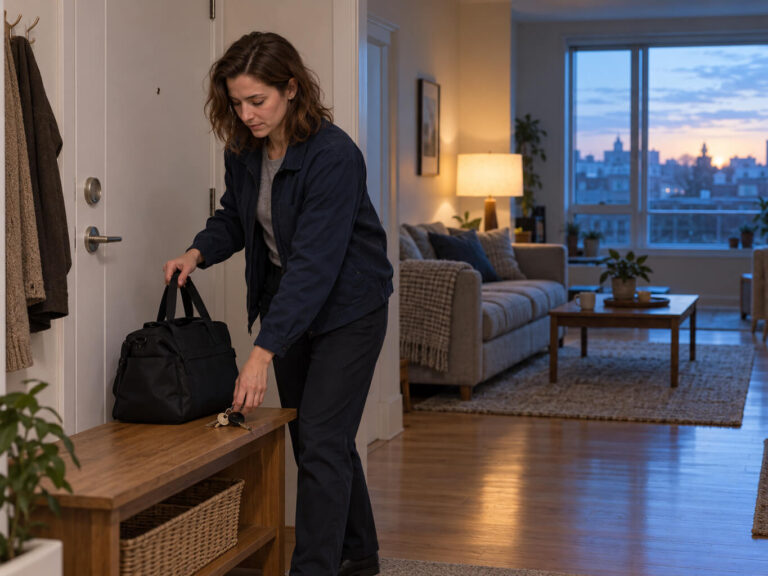
This is a good fit while you are still folding laundry, preparing for the next day, or moving between rooms. It is a poor fit if reducing illumination makes steps, obstacles, labels, faces, or essential details difficult to see. Safety wins that tradeoff.
Is red light before bed automatically better? No. A red-looking lamp may shift the spectrum, but color alone does not reveal intensity, duration, or the light reaching your eyes. Treat dimmer, warmer light as one possible room strategy—not as a guarantee or as the same thing as red-light therapy.
Screen settings: use brightness and warmth as separate controls
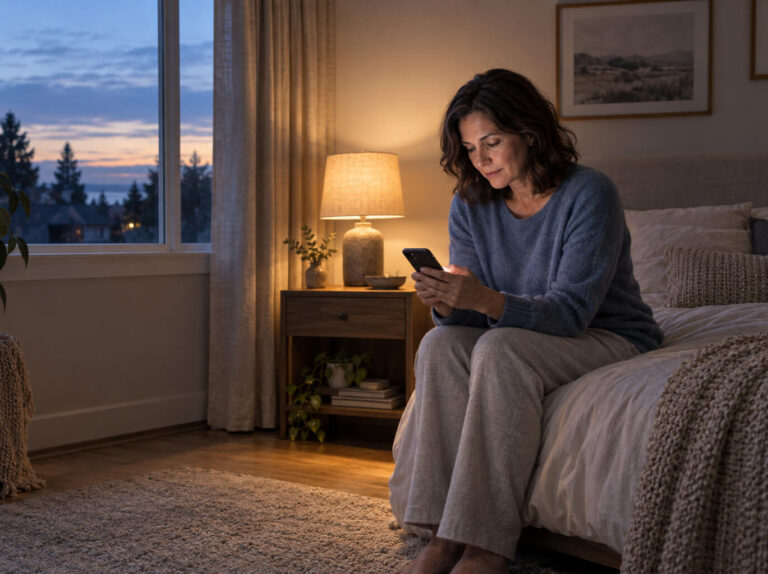
Night mode, Night Shift, or another scheduled warm setting can make a display look less cool. Brightness controls how much visible light the display emits. They are related choices, but they are not substitutes for one another.
A workable setup often has three parts:
reduce brightness until the screen is comfortable but still clearly readable;
schedule a warmer setting so you do not have to remember it nightly;
reduce contrast with the room by lowering nearby glare or using a small amount of task lighting.
Dark mode can help when a mostly white interface feels glaring, but its effect depends on the app, display, text size, and room. A dark interface can still contain bright images, videos, notifications, or white pages.
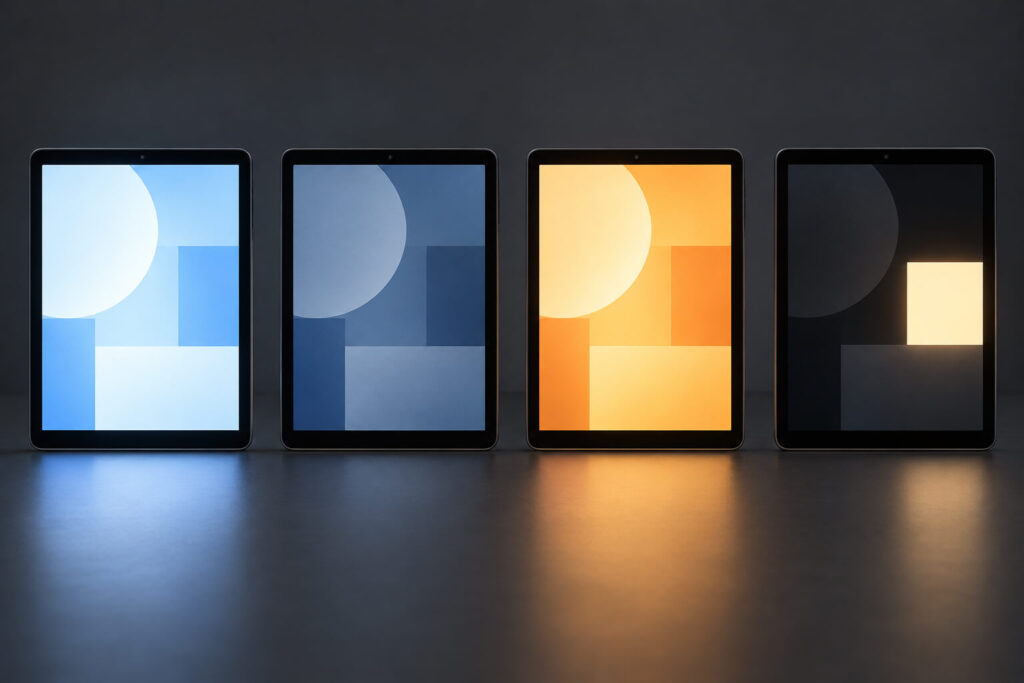
Brightness, warmth, and interface appearance change different parts of the viewing setup.
Is dark mode enough before bed? Usually not by itself. It changes interface appearance; it does not control room light, total viewing time, stimulating content, or every bright element on the screen. Use it if it improves your setup, but evaluate it alongside brightness, warmth, and the rest of the room.
Color-critical work is an obvious exception. If you are editing photographs, matching materials, or reading color-coded information, a warm display or colored lens may distort the information you need. Keep accurate color for the task, then shift to stronger light controls after the task is done.
Reading format: choose for the situation, not the label
The useful question in “reading before bed: screen vs book” is not simply whether one object is digital. It is how much light the full setup requires, how close it is, what else it invites you to do, and whether you can read without strain.
Paper does not emit light, but it still needs room or task lighting. A phone emits light and may bring messages, videos, and endless scrolling along with the text. An e-reader can sit between those experiences, depending on its display and front-light settings.
A paper book is not automatically the better fit in every practical situation. Paper removes a light-emitting display, but a bright lamp may offset part of that advantage. A dim, readable e-reader used for one quiet activity may be a better fit than a phone that keeps pulling you into other tasks. Compare the whole reading setup, not just the object.
For seated reading, try the format that lets you use the lowest comfortable combination of screen and room light without squinting or losing your place. For moving around or caregiving, prioritize clear, unrestricted vision instead of trying to maintain a reading-style low-light environment everywhere.
Timing: move demanding tasks when you can, not because a clock says so
A buffer before sleep can be useful when late work keeps both the room and your attention at full daytime intensity. The buffer does not need to follow a viral formula. Its purpose is to create a deliberate transition from demanding activity to a calmer, lower-light setting.
If a hard cutoff is unrealistic, make the final portion of the task less bright and less visually demanding. Finish color-sensitive or detail-heavy work first. Save audio, simple text review, or routine planning for later if those formats genuinely fit the job.
Do you have to stop using screens before bed? No. If screens are necessary, reduce the parts of the exposure you can control and avoid turning one missed cutoff into an all-or-nothing failure. A repeatable compromise is more useful than a severe rule you abandon after two nights.
Tint-based eyewear: optional, not the whole plan
Tinted lenses can change the spectrum and visible brightness reaching the eyes, so they can add another layer when room and device controls are not enough. The tradeoff is equally real: stronger or darker tints can reduce visibility and alter color judgment.
Independent spectral tests of Gloojo’s Orange, Red, and Dark Red lenses illustrate these filtering and visibility tradeoffs.
That makes tinted eyewear most compatible with seated, predictable tasks. The darker and more color-altering the lens, the narrower the suitable use case becomes. Follow the specific manufacturer’s safety instructions, and do not use bedtime tints for driving or road use. Very dark or strongly color-shifting lenses are a poor choice for walking around, chores, caregiving, stairs, low-light navigation, or any task that depends on natural color.
The evidence also does not support treating blue-light-filtering glasses as a sleep treatment. A Cochrane review found the sleep effect of blue-light-filtering spectacle lenses indeterminate because the trials varied in lenses, populations, and outcomes.
How long before bed should you wear blue-light glasses? There is no single evidence-based duration that fits every lens and every person. Product instructions may give a use window, but that is not proof of a universal sleep benefit. If you use a tint, judge it as one part of your setup: what you are doing, whether you can see safely, how strong the control is, and whether the routine is realistic.
Reserve strict control for a narrow, safe use case
Strict control means layering several measures: low room light, a dimmer and warmer display or no display, limited duration, and possibly a very strong tint. It can make sense when you are finished with essential tasks, will remain seated or in bed, and can keep the environment free of hazards.
It is not a badge of discipline, and it is not the default for an active household. Do not use a strict setup when you might need to:
drive, cycle, or use a road;
walk through dim rooms or use stairs;
cook, clean, or handle tools;
provide hands-on care or respond quickly to another person;
read medication labels or judge color-coded information;
do any task for which reduced brightness or shifted color could cause an error.
Use strict light control only after movement and safety-critical tasks are finished.
If the evening may change unexpectedly, stay with a modest setup until the mobile or safety-critical part is over. Move to strict control only after the context becomes predictable.
Build a routine that can survive a normal week
Pick one setup for each of your common evening contexts rather than one universal rule.
Active evening: reduce overhead brightness and glare; keep enough neutral light for movement and care.
Seated screen or reading time: lower display brightness, schedule warmth, and choose a format that remains easy to read.
Final stationary period: if desired, layer stronger controls after essential tasks are complete.
Keep light management in proportion. NHLBI’s healthy-sleep guidance pairs reduced bright artificial light with regular timing and quiet time before bed; it does not present one screen setting or pair of glasses as the whole routine.
For the next few evenings, notice two things: whether the setup leaves you enough visibility for the task, and whether you can follow it without repeatedly breaking it. If either answer is no, adjust the fit. The best bedtime light strategy is not the darkest possible evening. It is the lowest-light setup that still lets you finish the evening clearly, safely, and consistently.
Disclaimer
This article is for educational purposes only and is not medical advice. Gloojo Night Ease™ Sleep Glasses are not intended to diagnose, treat, cure, or prevent insomnia, sleep disorders, circadian rhythm disorders, or any medical condition. If you have chronic sleep problems, take medication, are pregnant or nursing, or are considering sleep supplements, please speak with a qualified healthcare professional.