Use the promo code to enjoy a 10% discount storewide.
Is Blue Light Bad for Sleep? Research on Blue Light & Sleep Quality
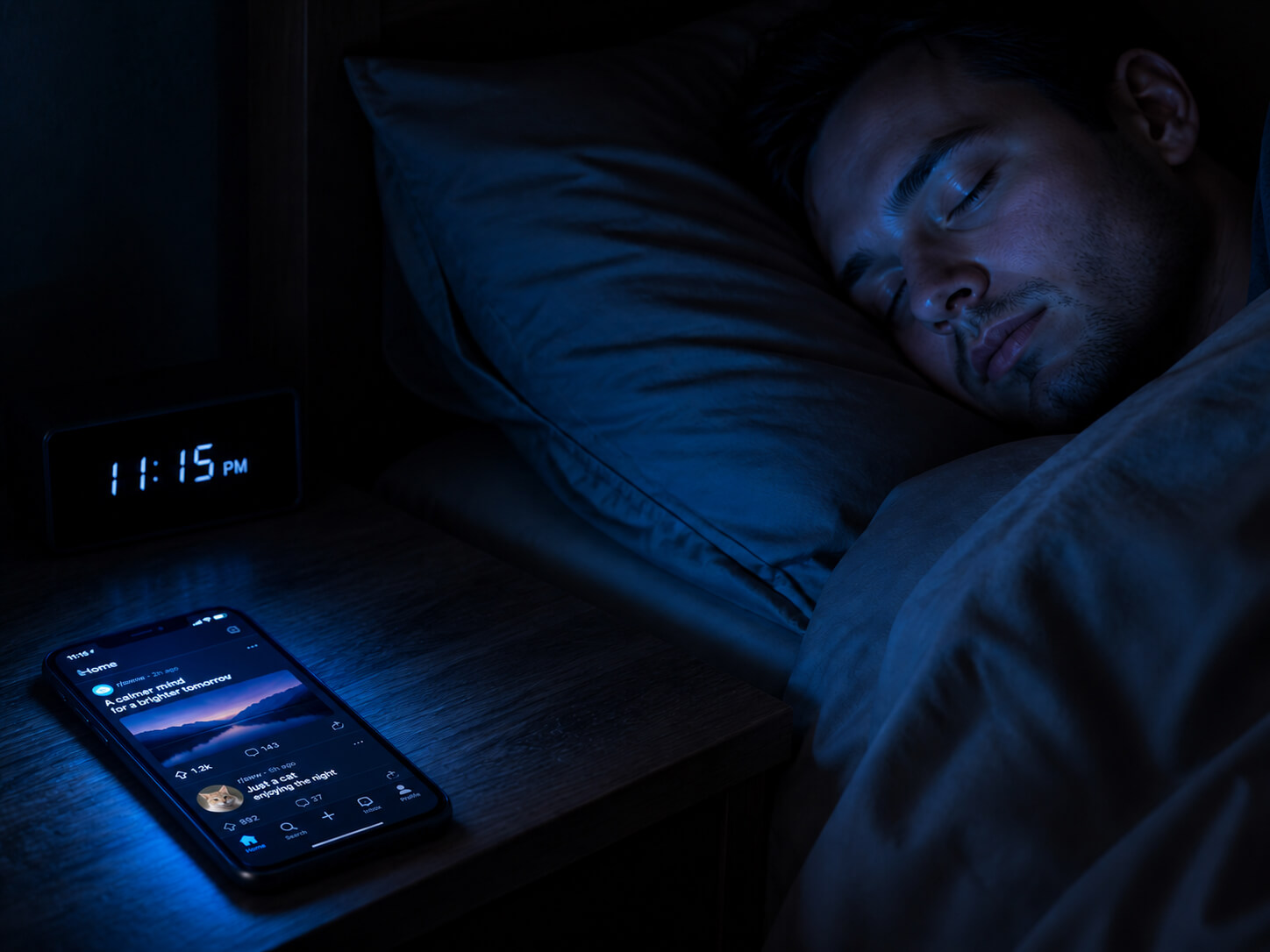
Evening light — not only its blue component — can shift melatonin production and sleep timing. Blue-light filtering glasses show mixed results in systematic reviews, and normal screen use has not been shown to damage the eyes. Overall brightness, timing, and duration matter more than color labels alone.
What is blue light, and why does everyone talk about it at bedtime?
Blue light is a short-wavelength segment of the visible light spectrum, roughly between 450 and 495 nanometers. It’s present in sunlight, LED bulbs, and the screens on phones, tablets, and laptops.
The reason it comes up in sleep conversations is that the human eye contains a special set of light-sensitive cells — intrinsically photosensitive retinal ganglion cells, or ipRGCs — that are particularly responsive to short-wavelength light. These cells don’t help you see. Instead, they send signals to your brain’s master clock, the suprachiasmatic nucleus, telling it whether it’s daytime or nighttime. When these cells detect light in the evening, they can delay the release of melatonin, the hormone that helps you feel drowsy (NIGMS Circadian Rhythms).
That’s the basic mechanism. The question is how much this matters in practice — and that’s where the evidence gets layered.
What does the research actually show about blue light and melatonin?
This is where the evidence is strongest.
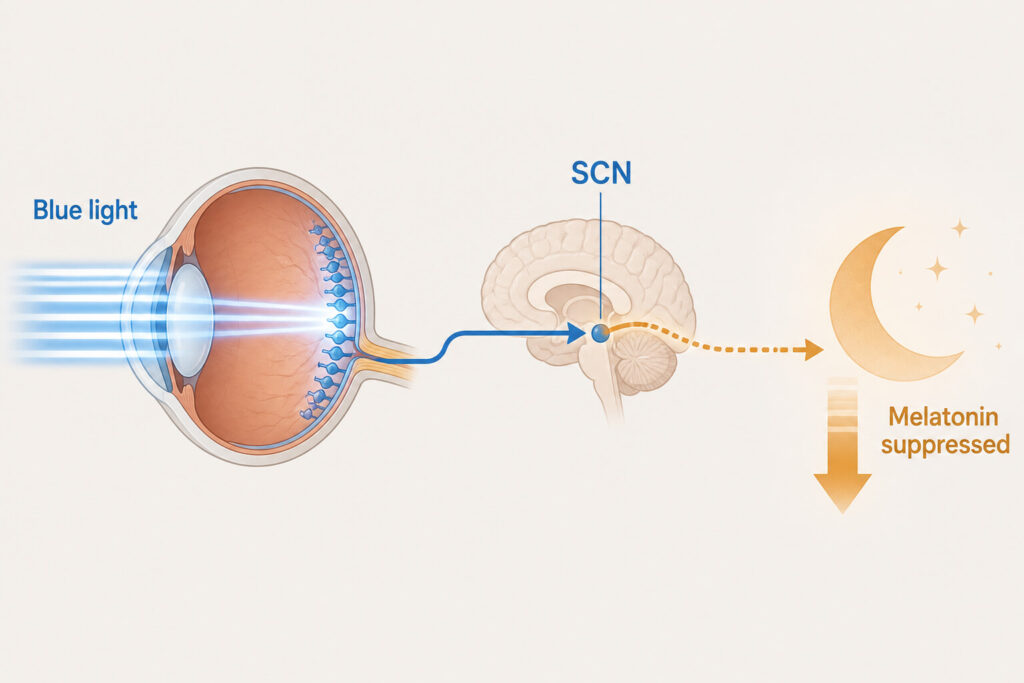
In a well-known experiment, Harvard researchers exposed volunteers to 6.5 hours of blue light and compared the results to a group exposed to equally bright green light. The blue light suppressed melatonin production for about twice as long and shifted circadian rhythms by roughly 3 hours, compared to 1.5 hours for the green light. The University of Toronto ran a related study: people wearing blue-light-blocking goggles under bright indoor light had melatonin levels similar to people in dim light without goggles — supporting the idea that blue wavelengths are a key driver of melatonin suppression under bright conditions.
A controlled study published in the Journal of Clinical Endocrinology & Metabolism compared melatonin profiles in healthy adults under room light (below about 200 lux) and dim light (below 3 lux) before bedtime. Ordinary room light delayed melatonin onset and shortened melatonin duration, and room light during usual sleep hours suppressed melatonin in most trials. The researchers found that even typical household lighting — not just screens — can mask melatonin onset and shorten the duration of melatonin secretion overnight.
A 2024 narrative review cited research showing that after 2 hours of LED tablet exposure, students exhibited a 55 percent decrease in melatonin and an average 1.5-hour delay in melatonin onset compared to reading a printed book under low light. The review also noted that genetic variations may make some people more susceptible to melatonin suppression than others.
Bottom line: Light’s ability to suppress melatonin and shift circadian timing is one of the more solid findings in sleep science. The mechanism is well-characterized, and multiple independent studies confirm it.
Does blue light from screens actually disrupt sleep, or is it mostly hype?
Here’s where the picture shifts from “well-established” to “more complicated than you’d think.”
A 2023 study in Communications Biology directly tested this question. Researchers exposed 72 healthy men to screens at different brightness levels and controlled the melanopic irradiance — the specific measure of how much light activates those circadian-signaling cells — independently from the screen’s overall brightness or color. Their finding: melanopic irradiance dose-dependently affected sleep latency and melatonin levels. Lower melanopic light meant falling asleep faster and less melatonin disruption. Alertness differed between conditions but did not show the same dose-dependent pattern.
But here’s the key context: evening screen light levels are typically far below what you receive from natural daylight. A 2023 Cochrane systematic review noted this gap when evaluating the evidence on screen-related light exposure.
A 2022 systematic review of blue light research in young adults found that three out of five studies showed no significant change in sleep quality from blue light exposure. The results were genuinely split — one study found blue light improved sleep quality, another found it worsened it.
Bottom line: Evening screen use can delay sleep onset and suppress melatonin, particularly at high brightness and long duration. But it’s not the same as staring into a bright light source. The effect is real but modest for most typical phone or laptop use, and brightness, duration, and spectrum all matter more than the “blue light” label alone would suggest.
Do blue light glasses actually help you sleep better?
This is the question where the marketing has run furthest ahead of the evidence.
A 2023 Cochrane systematic review — covering 17 randomized controlled trials with over 600 participants — evaluated blue-light filtering spectacle lenses. For eye strain, the review found that blue-light filtering lenses may not reduce symptoms over short-term follow-up (low-certainty evidence). For sleep quality, the evidence was indeterminate: three of six sleep trials reported improvement, three found no difference. The review authors noted that the heterogeneity of study populations and short follow-up periods made it hard to draw firm conclusions in either direction.
A 2025 meta-analysis pooled three double-blind crossover randomized trials with 49 adults and examined objective sleep measurements. Blue-light blocking glasses showed directionally favorable but statistically non-significant changes in sleep-onset latency, total sleep time, and sleep efficiency. The analysis was small and may have been underpowered to detect modest effects.
A 2020 meta-analysis of 12 intervention studies found a different pattern: self-reported sleep quality improved substantially, while objective measures like total sleep time and sleep efficiency showed smaller, less consistent effects. The contrast between the two pooled analyses highlights a recurring gap — subjective improvements sometimes appear where objective measures do not.
There is one notable exception for a specific population. A small randomized crossover trial in adults already experiencing insomnia symptoms found that amber blue-blocking lenses worn for two hours before bedtime improved insomnia scores and some self-reported sleep measures. This suggests that people with existing sleep difficulties may respond differently from healthy sleepers — but the sample was small and the intervention lasted only one week.
Harvard neuroscientist Dr. Steven Lockley noted that the timing, duration, and nature of nighttime light exposure in existing studies was often unclear, making it difficult to know whether blue light glasses help under specific circumstances or whether the inconsistent results reflect inconsistent study designs.
Reported side effects in trials were temporary and generally mild, though harms were not consistently reported and the evidence is limited.
Bottom line: The best available evidence doesn’t support strong claims about blue light glasses and sleep. If they help you, it may be because they’re part of a broader evening routine that reduces screen time — not because the filtering itself is doing the heavy lifting.
Does blue light affect sleep, or is it just brightness?
This is one of the most useful reframes in the current research, and the 2023 Communications Biology study is particularly instructive here.
By separating melanopic irradiance from screen brightness and color, the researchers showed that it’s specifically the melanopic signal — the light that activates your circadian system — that drives sleep disruption, not brightness per se. A dim screen with high melanopic content can disrupt melatonin more than a brighter screen with low melanopic content.
At the same time, the room-light study found that ordinary ambient lighting (below about 200 lux) suppressed melatonin compared to dim light conditions. And a 2025 study found that typical home lighting can induce significant melatonin suppression, with LED sources generally producing more circadian disruption than older incandescent bulbs.
So it’s not purely a brightness story, and it’s not purely a blue-light story. The spectrum, the intensity, the duration, and the timing all interact. Blue wavelength light is more potent at suppressing melatonin per photon, but total light exposure — which includes brightness and duration — often matters in real-world settings alongside the blue component.
What is melanopic irradiance, and why does it matter?
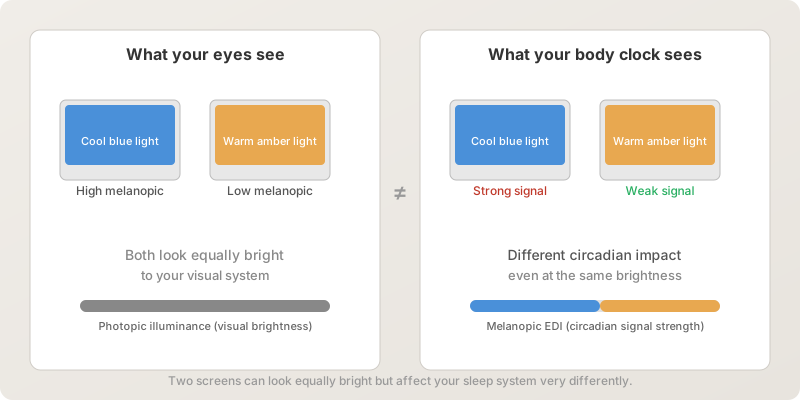
Melanopic irradiance is a measurement of how much light reaches those circadian-signaling cells in your eye — the ipRGCs. Unlike regular brightness (photopic illuminance), which measures what your visual system sees, melanopic irradiance measures what your body clock “sees.”
The metric is called melanopic Equivalent Daylight Illuminance, or melanopic EDI, and it’s expressed in lux. It weights the light spectrum according to how strongly it activates melanopsin, the photopigment in ipRGCs that’s most sensitive to short-wavelength light around 480 nanometers.
Why this matters for your evening routine: two screens can look equally bright to your eyes but have very different effects on your circadian system. A screen with higher melanopic irradiance — more short-wavelength content — sends a stronger “daytime” signal to your brain, even if it doesn’t seem any brighter. An expert consensus published in PLOS Biology recommends using melanopic EDI rather than color labels alone when considering the circadian effects of light, and this metric is increasingly used in lighting design and sleep research.
Is blue light from phones harmful to your eyes?
A common claim in popular coverage is that blue light from screens damages your eyes or retina. The evidence does not support this for normal screen use.
The International Commission on Illumination (CIE) has clarified that the technical term “blue light hazard” refers specifically to photochemical retinal injury under conditions of high radiance and duration — and should not be applied loosely to everyday screen viewing. A European Commission scientific committee similarly concluded that there is no evidence of direct adverse health effects from normal LED screen use by the general healthy population, noting that screen radiance is well below retinal safety limits in assessed conditions.
Digital eye strain — the dry, tired feeling after long screen sessions — is real, but it’s primarily caused by reduced blinking, prolonged near work, and environmental factors like glare and dry air, not by blue wavelengths specifically.
Bottom line: Normal screen use has not been shown to damage your eyes. The discomfort people experience during long screen sessions is better explained by focusing demands, incomplete blinking, and environmental conditions.
Popular claims vs. what the evidence shows
| Popular Claim | What the Evidence Says |
|---|---|
| Blue light from screens ruins your sleep | Evening screen light can delay melatonin and sleep onset, but at levels typically far below daylight. Effect is real but modest for typical use. |
| Blue light glasses protect your sleep | A Cochrane review of 17 RCTs found mixed results — three of six sleep trials showed improvement, three found no difference. Evidence is indeterminate. |
| Blue light is uniquely harmful | Blue wavelengths are more potent at melatonin suppression per photon, but total exposure (brightness × duration) also matters in practice. |
| Only blue light disrupts your clock | Any bright light in the evening can suppress melatonin. Room light (below about 200 lux) produces measurable suppression compared to dim conditions. |
| Night mode on your phone eliminates the problem | Night mode reduces melanopic content and helps, but doesn’t eliminate it. Brightness and duration still contribute. |
| Blue light from screens damages your eyes | Normal screen use has not been shown to cause retinal damage. Screen radiance is well below safety limits. |
What actually matters for your evening light environment
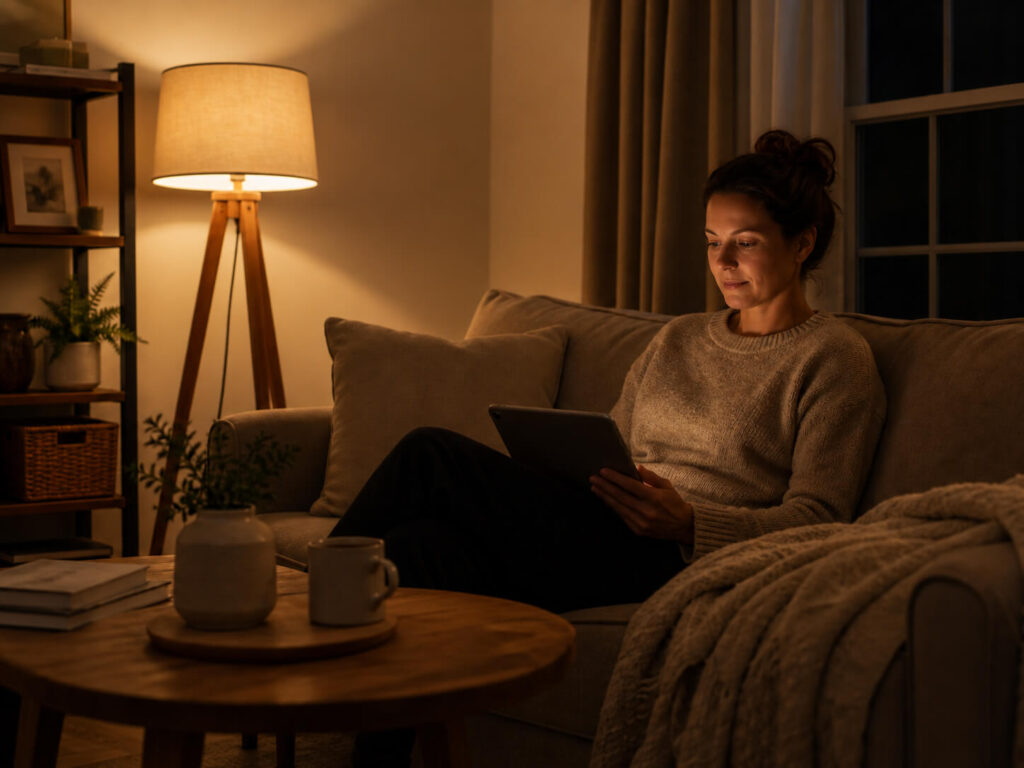
Based on the current research, the factors that influence how much your evening light exposure affects sleep include:
Timing. Light exposure in the hours before bed can affect melatonin onset and circadian phase. Expert consensus recommends reducing melanopic exposure during the three hours before sleep.
Total brightness. Dimming your environment in the evening is one of the most evidence-backed steps you can take. Room light under typical indoor conditions can suppress melatonin compared to dim light.
Duration. A quick glance at your phone is different from hours of laptop work. Longer exposure accumulates more circadian disruption.
Spectrum (melanopic content). Screens and LED bulbs with higher short-wavelength content send a stronger circadian signal. Night mode and warmer lighting reduce this, though they don’t eliminate it entirely.
One important caveat: people respond very differently to the same light environment. Research has shown that the light level producing a half-maximal melatonin response can vary by more than tenfold between individuals. This means universal rules — “stop looking at screens two hours before bed” or “blue light glasses will fix your sleep” — are unlikely to apply equally to everyone.
*The research doesn’t support a single magic fix. It supports the idea that your overall evening light environment — how bright, how long, and what spectrum — is what shapes the effect on your sleep. And what works best may be different for you than for someone else.
Disclaimer
This article is for educational purposes only and is not medical advice. Gloojo Night Ease™ Sleep Glasses are not intended to diagnose, treat, cure, or prevent insomnia, sleep disorders, circadian rhythm disorders, or any medical condition. If you have chronic sleep problems, take medication, are pregnant or nursing, or are considering sleep supplements, please speak with a qualified healthcare professional.