Use the promo code to enjoy a 10% discount storewide.
Why Fluorescent and LED Office Lights Can Trigger Migraines — and What to Do About It
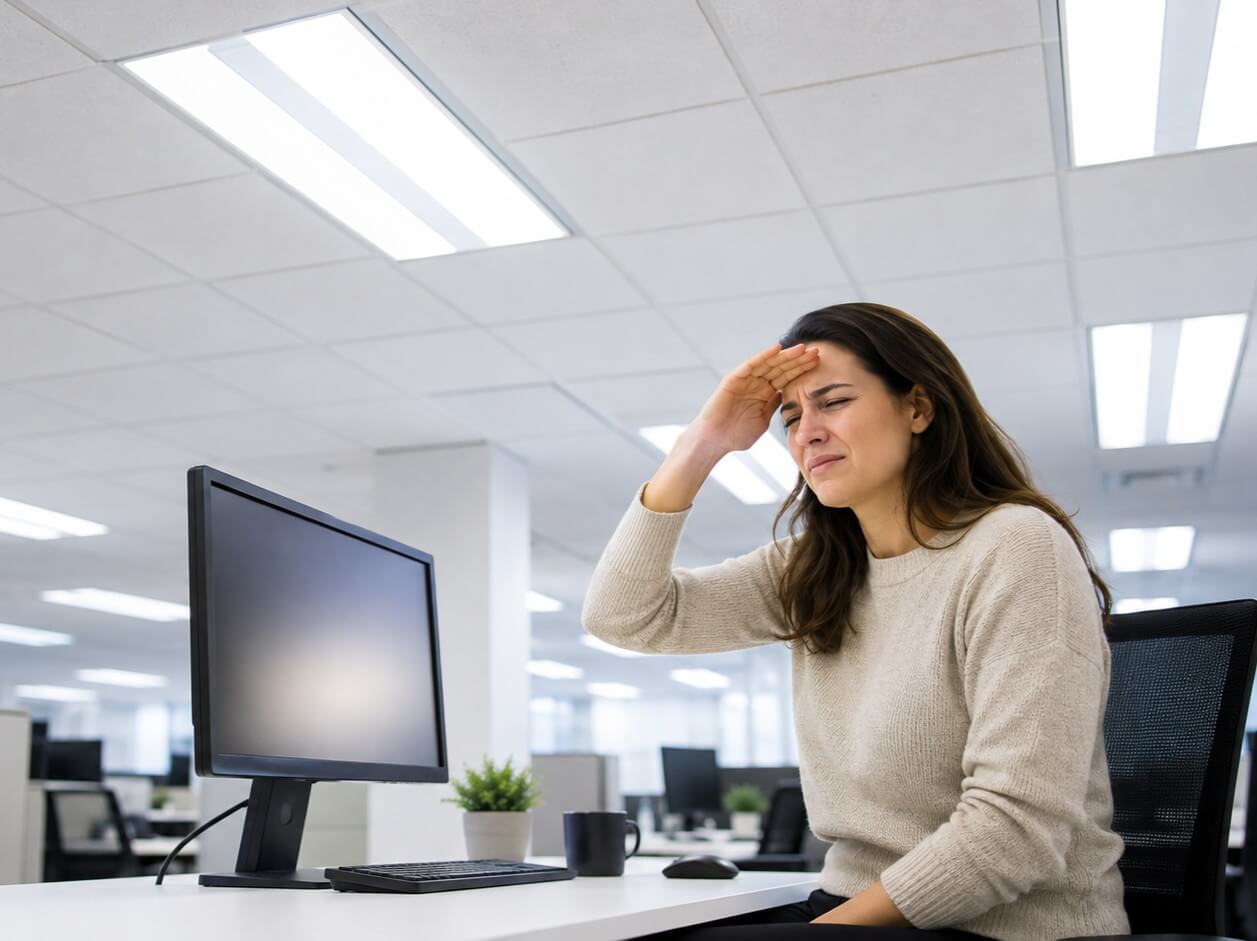
Fluorescent and LED lighting each produce flicker, spectral spikes in blue and green wavelengths, and often higher intensity than older incandescent bulbs — and migraine-sensitive visual systems can respond to each of these properties differently than the general population. Understanding which specific aspects of your lighting environment matter most gives you more targeted options than simply “avoiding light.”
If you have ever walked into an office, a hospital corridor, or a retail store and felt a familiar tightness building behind your eyes, you are not imagining it. Indoor lighting — especially the fluorescent tubes and LED panels that fill most commercial and institutional spaces — is not just “bright light.” It has specific physical properties that can interact with the heightened visual sensitivity common in migraine. And those properties vary enough between light types that the same room can feel perfectly tolerable under one setup and unbearable under another.
This article breaks down what makes fluorescent and LED lighting particularly challenging for people with migraine, and walks through practical strategies organized by how much control you actually have over the situation.
What Makes Fluorescent Lighting a Problem for Migraine?
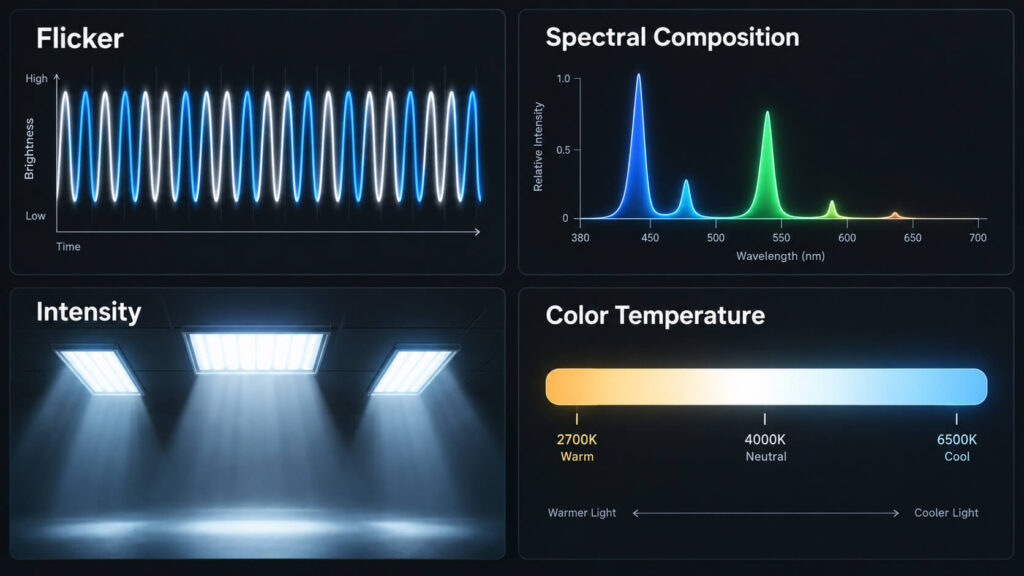
Fluorescent lighting — the long tubes found in most offices, schools, hospitals, and warehouses — has four properties that matter for migraine-sensitive individuals: flicker, spectral composition, intensity, and color temperature.
Flicker
All fluorescent lamps produce flicker. The rate depends on the ballast — the device that regulates electrical current to the tube.
Older magnetic ballasts (still common in many buildings) drive the lamp at twice the AC supply frequency, producing flicker around 100 Hz (in 50 Hz regions) or 120 Hz (in 60 Hz regions). This is fast enough that most people do not consciously perceive it as flashing. But the human visual system can detect flicker well above the conscious perception threshold — depending on modulation and waveform, the optic nerve and visual cortex can respond to stimuli up to 160 Hz, and retinal responses have been detected up to 200 Hz in tests.
A 1974 survey of UK office workers under magnetically-ballasted fluorescent lighting found that headaches and eyestrain were commonly reported, and roughly one in four workers said they could see the lamps flickering. Electronic ballasts — which operate at much higher frequencies, typically above 20,000 Hz — produce far less visible flicker than the older magnetic type.
A 2025 case report published in the NIH’s PubMed Central described a 32-year-old assembly line worker who experienced a migraine attack triggered by flickering fluorescent lights on the factory floor. When occupational safety inspected the fixtures, they confirmed that aging ballasts were producing visible flicker. The attacks stopped after the worker was moved to stations with stable LED lighting and given permission for breaks in low-light areas.
The key point: even when you cannot consciously see fluorescent flicker, your visual system may still be processing it — and for people with migraine, that processing can contribute to discomfort or attack onset.
Spectral Composition
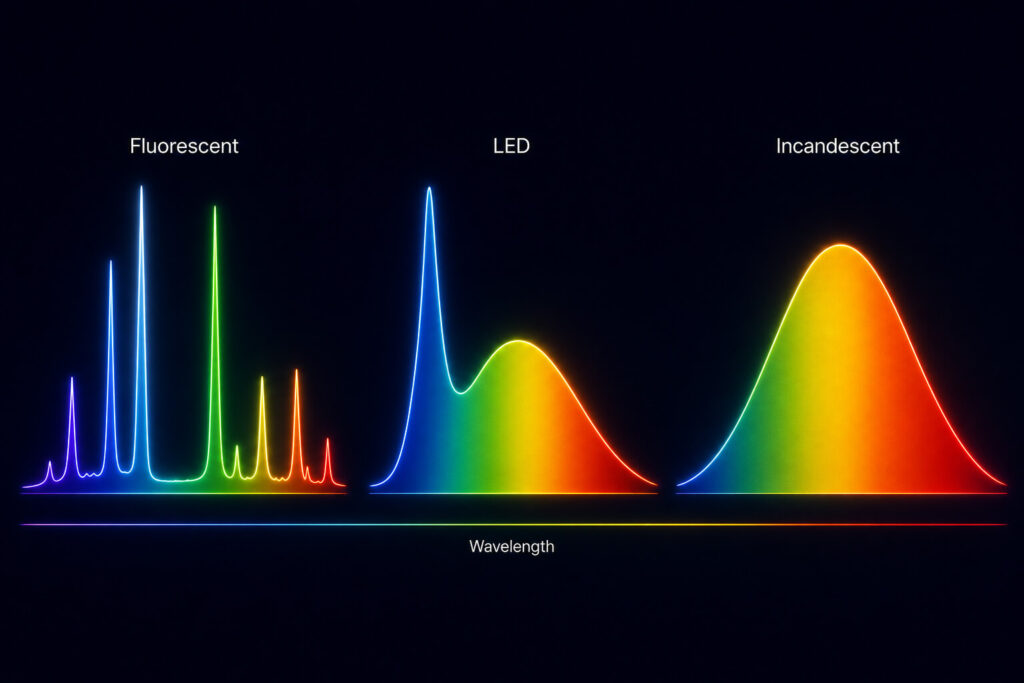
Fluorescent lamps do not produce a smooth, even spectrum of light. Instead, they emit energy at specific wavelengths determined by the mercury vapor and phosphor coating inside the tube. The result is a “spiky” spectrum with pronounced peaks in the blue region (around 435 nm) and the green region (around 546 nm), with gaps in between.
This is fundamentally different from incandescent light, which produces a smooth, continuous spectrum weighted toward warm red and yellow tones. The spiky spectral output of fluorescent lighting means your eyes are receiving concentrated energy at certain wavelengths rather than a balanced spread across the visible spectrum. Research on migraine-related photophobia suggests that sensitivity in migraine involves multiple distinct visual dimensions — including brightness, flicker, pattern glare, and color — rather than a single response to “bright light.”
Intensity
Commercial fluorescent fixtures are typically designed for maximum task visibility at minimum energy cost. In open-plan offices, retail spaces, and institutional settings, the result is often uniform overhead lighting at levels that may be significantly higher than what an individual finds comfortable — especially someone with migraine-related photophobia.
The problem is rarely a single tube. It is the cumulative effect of dozens of fixtures covering an entire ceiling, creating a diffuse field of high-intensity light with no natural variation or escape. The American Migraine Foundation notes that both natural and artificial light can worsen migraine-related discomfort, and that environmental adjustments are a reasonable part of managing sensitivity.
Color Temperature
Fluorescent tubes come in a range of color temperatures, measured in Kelvin (K). “Cool white” tubes — common in offices and institutional settings — typically output in the 4000–5000K range, which produces a bluish-white light. “Warm white” tubes (2700–3000K) produce a more yellow-amber tone closer to incandescent light.
Higher color temperature means more blue spectral content. For some migraine-sensitive individuals, cooler color temperatures contribute to visual discomfort — though it is worth noting that no clinical threshold has been established for a “safe” color temperature for migraine. The relationship is individual and may interact with the other properties listed here.
How LED Lighting Is Similar — and Different
LED lighting has become the default in new construction and retrofit projects, largely because of energy efficiency and longevity. But LEDs present their own set of challenges for migraine-sensitive individuals, and they are not simply “better fluorescent lights.”
Flicker: A Different Source, Not Necessarily Less
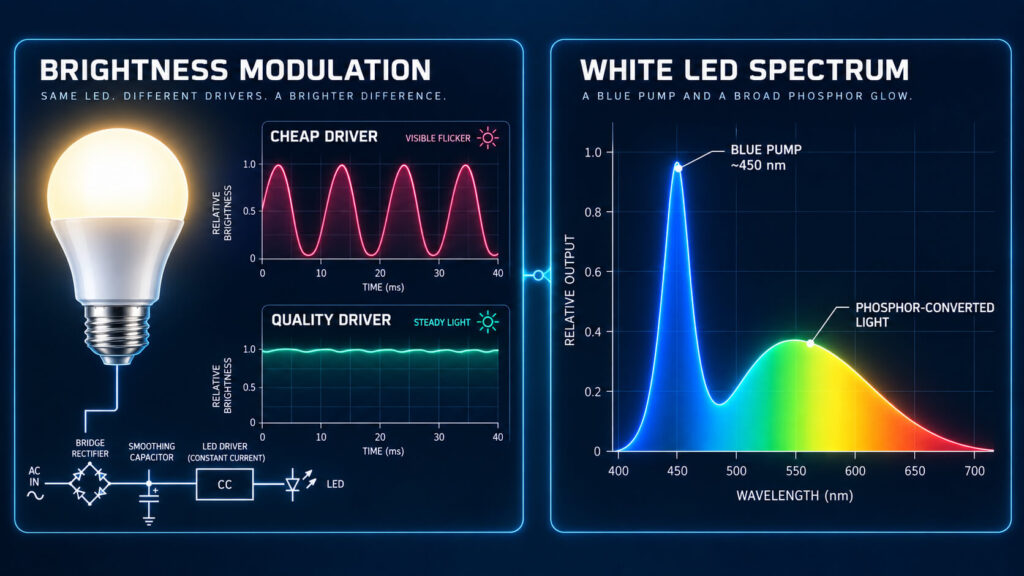
LED flicker comes from a different mechanism than fluorescent flicker. LEDs are driven by electronic drivers that convert AC power to the DC power the LED needs. Cheap or poorly designed drivers may not fully smooth out the AC ripple, producing flicker at the same 100/120 Hz rate as older fluorescent ballasts — but potentially with greater modulation depth (the difference between peak and trough brightness).
According to an industry summary of the IEEE 1789 flicker standard, health effects from flicker — including headaches, migraine attacks, and fatigue — have been documented even at frequencies above 100 Hz. Testing of LED products around 100 Hz has measured modulation depths ranging from under 1 percent to over 90 percent, meaning some cheap LED bulbs produce brightness swings far more pronounced than typical fluorescent lighting.
Quality LED drivers produce minimal or no perceptible flicker. The problem is that flicker performance varies enormously between products, and it is rarely stated on packaging or product listings. A cheap LED bulb from a discount store may flicker significantly more than a premium one — and the consumer has no easy way to tell.
Spectral Composition: The Blue Peak
White LEDs work by combining a blue LED chip with a phosphor coating that converts some of the blue light into longer wavelengths (green, yellow, red). The result is a more continuous spectrum than fluorescent light, but with a characteristic spike in the blue region around 450 nm.
Cool-white LEDs (5000–6500K) have a particularly strong blue component. Warm-white LEDs (2700–3000K) shift more energy toward longer wavelengths through additional phosphor conversion, but the blue peak remains. Compared to incandescent light’s smooth, warm spectrum, LED light — especially cool-white LED — delivers proportionally more energy in the blue wavelengths that migraine research has identified as potentially more aggravating for sensitive individuals.
Intensity: Panels and Downlights
LED technology enables extremely bright, compact light sources. LED panel lights — common in modern offices — can produce high, uniform illumination across large areas. LED downlights and spotlights can create intense, focused beams. In both cases, the intensity can be higher than what older fluorescent or incandescent systems produced, especially when building designers prioritize energy efficiency over occupant comfort.
Color Temperature: Same Range, Same Concerns
Like fluorescent tubes, LEDs are available across a wide color temperature range. The same concern applies: cool-white LEDs above 4000K carry more blue spectral content, and many commercial installations default to cool white for perceived brightness and energy efficiency.
Higher color temperature means more blue spectral content. For some migraine-sensitive individuals, cooler color temperatures contribute to visual discomfort — though it is worth noting that no clinical threshold has been established for a “safe” color temperature for migraine. The relationship is individual and may interact with the other properties listed here.
Why People with Migraine Respond Differently
Migraine-related photophobia is not simply “being bothered by bright light.” Research describes it as a cluster of distinct visual sensitivities — to brightness, flicker, spatial patterns (like striped or gridded surfaces), and color. These dimensions can operate independently: a person might tolerate overall brightness but be highly sensitive to flicker, or find a room comfortable until they look at a high-contrast striped wall.
This helps explain why some indoor environments feel worse than others even when the overall light level seems similar. A room lit by flicker-free, warm-white, diffused incandescent fixtures may feel comfortable, while the same room under cool-white fluorescent tubes with aging ballasts — adding flicker on top of blue-heavy spectral spikes — can feel intolerable. The light level might be comparable, but the specific properties are very different.
Common Indoor Environments and Which Properties Dominate
Different indoor settings present different combinations of lighting challenges:
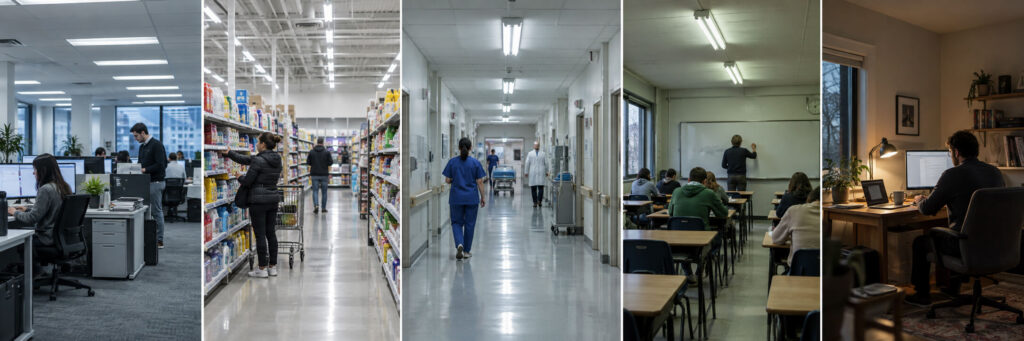
Open-plan offices. Typically lit by overhead fluorescent tubes or LED panels. The main challenges are flicker (especially with older fluorescent fixtures), high uniform intensity with no variation, and cool color temperature. The sheer ceiling area covered by fixtures means the light is diffuse and inescapable.
Retail stores and supermarkets. Often use a mix of fluorescent and LED lighting, sometimes at very high intensity. The combination of bright overhead lighting, reflective surfaces, and visual complexity (shelves, signage, packaging) can trigger pattern glare as well as brightness and flicker sensitivity.
Hospitals and clinics. Clinical spaces often use high-intensity cool-white lighting for examination purposes. Waiting areas may have mixed lighting. The fluorescent tubes common in older hospital corridors can be particularly problematic.
Schools and universities. Classrooms with older fluorescent fixtures present flicker and spectral concerns. Extended exposure during lectures and exams adds duration as a compounding factor.
Warehouses and factories. High-intensity overhead fluorescent or LED lighting, often at very high mounting heights. The assembly-line context in the 2025 NIH case report illustrates how prolonged industrial exposure to flickering fluorescent lighting can trigger migraine in susceptible workers.
Home offices. Overhead LED panels or bulbs, often chosen for cost rather than flicker quality. Desk placement relative to windows and overhead fixtures matters here — and the reader has the most control over this environment.
Flickering Lights: Trigger or Aura?
There is a common and important point of confusion here. When people search for “flickering lights migraine,” many of the results that come up are about migraine aura — the visual disturbances (flashing lights, zigzag lines, blind spots) that can occur before or during a migraine attack. Aura-related visual phenomena are neurological events happening inside the brain, not a response to external lighting.
This article is about something different: external flicker from artificial lighting acting as a trigger or aggravating factor for migraine-sensitive individuals. These are two distinct phenomena. If you experience new, sudden, or unusual visual disturbances — especially flashing lights that move across your visual field, zigzag patterns, or temporary vision loss — that warrants medical evaluation rather than a lighting adjustment.
What You Can Actually Do: Strategies by Controllability
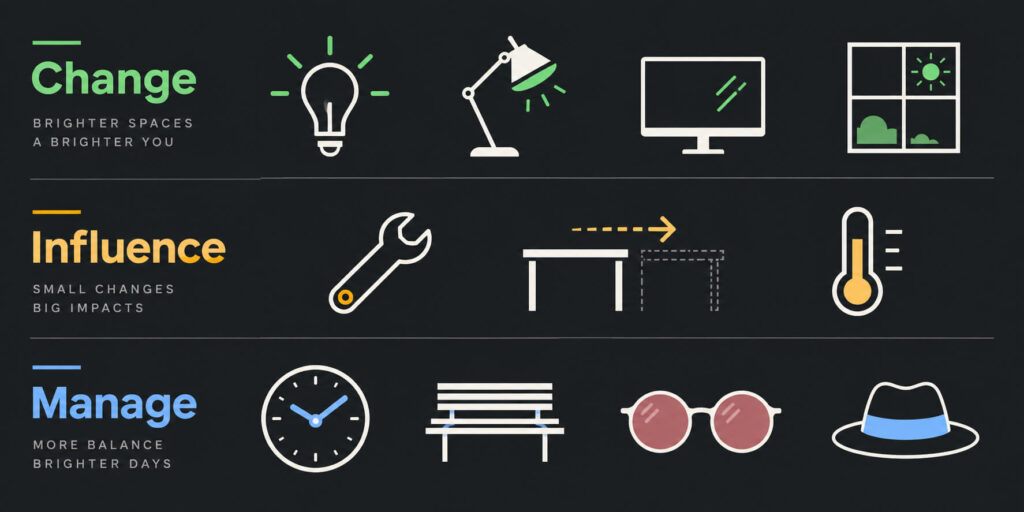
Not all lighting environments are equally modifiable. The most useful approach is to think about strategies in three tiers: what you can change directly, what you can influence through requests, and what you can only manage.
This article is about something different: external flicker from artificial lighting acting as a trigger or aggravating factor for migraine-sensitive individuals. These are two distinct phenomena. If you experience new, sudden, or unusual visual disturbances — especially flashing lights that move across your visual field, zigzag patterns, or temporary vision loss — that warrants medical evaluation rather than a lighting adjustment.
What You Can Change
These are strategies for environments where you have direct control — typically your home, your personal workspace, or spaces you can modify.
Choose your bulbs carefully. If you use LED bulbs at home, look for products marketed as “flicker-free” or check for IEEE 1789 compliance. Warm-white LEDs (2700–3000K) reduce blue spectral content compared to cool-white options. Incandescent and halogen bulbs produce the smoothest, most continuous spectrum — though they are being phased out in many markets for energy reasons.
Use task lighting instead of overhead lighting. A desk lamp with a quality LED or incandescent bulb gives you control over intensity, direction, and color temperature. Positioning the light to the side rather than directly above reduces the amount of diffuse overhead light your eyes process.
Adjust your screen. Most devices offer color temperature settings (often called “night mode” or “warm display”). Reducing blue light output from screens, especially in the evening, is a simple adjustment. External screen filters are also available.
Position yourself relative to windows. Many people find natural light more comfortable than artificial lighting, but direct sunlight through a window can create intensity spikes and glare. Positioning your desk perpendicular to windows — getting light from the side rather than directly in front or behind your screen — often works best.
What You Can Influence
These strategies apply to workplaces, shared spaces, and other environments where you cannot make changes yourself but can make requests.
Ask about lighting maintenance. In the NIH case report, the implicated factor was aging fluorescent ballasts producing visible flicker. A facilities request to inspect or replace aging fixtures — or to switch to electronic ballasts — is a concrete, reasonable ask. Many building managers may be unaware that aging fixtures produce more flicker than new ones.
Request a desk relocation. Moving away from directly underneath overhead fluorescent fixtures, closer to a window, or into an area with different lighting can make a meaningful difference. This is a commonly suggested workplace accommodation for light sensitivity.
Ask about color temperature. Some modern LED systems allow color temperature adjustment. Requesting warmer color temperatures (3000–3500K rather than 5000K+) in your work area is a reasonable accommodation request.
Propose task lighting. Some employers will provide a desk lamp as a reasonable accommodation, allowing you to reduce or turn off overhead lighting in your immediate area.
What You Can Only Manage
Public spaces, stores, other people’s offices, and institutional environments are places where you cannot change the lighting and are unlikely to get it changed. These strategies focus on managing your exposure.
Plan your timing. If certain environments reliably trigger discomfort, scheduling shorter visits or visiting during less busy times (when fewer lights may be on) can help reduce cumulative exposure.
Take breaks in low-light areas. Stepping outside or into a hallway, stairwell, or restroom with different lighting for even a few minutes can provide relief during extended exposure.
Consider light-management eyewear. For environments you cannot modify, tinted lenses designed for light sensitivity can help manage the visual input your eyes receive. Rose and gray tints are two options designed for people who are sensitive to fluorescent or harsh indoor light. The rose tint is a classic FL-41-style option that filters specific wavelengths while maintaining moderate visible light transmission; the gray tint offers a more neutral, subtle appearance. Either may help reduce light-related discomfort associated with migraines — though they are one tool among several, not a standalone solution.
Use brimmed headwear. A hat with a brim can reduce the amount of overhead light reaching your eyes from above, which is the primary direction of most commercial overhead lighting. This is a simple, zero-cost intervention that many people overlook.
When to Talk to a Professional
Light sensitivity that is new, worsening, persistent, or accompanied by other neurological symptoms — such as visual disturbances, weakness, numbness, or speech changes — warrants professional evaluation. Photophobia occurs in migraine, but it also occurs in other neurological and eye conditions, and the underlying cause matters for management. If you find yourself progressively avoiding more and more lighting environments, that pattern itself is worth discussing with a healthcare provider — the American Migraine Foundation cautions that continuous retreat into darkness may actually increase sensitivity over time.
Understanding Your Lighting Gives You Better Options
The goal is not to avoid all artificial light. It is to understand which specific properties of your lighting environment — flicker, spectral composition, intensity, color temperature — may be contributing to your discomfort, and to target your adjustments accordingly. A warm-white, flicker-free LED desk lamp in a home office addresses the problem differently than tinted eyewear in a fluorescent-lit supermarket, and both address it differently than asking your facilities manager to inspect aging ballasts. Knowing which property matters most in a given environment lets you choose the right strategy instead of relying on blanket avoidance.
Disclaimer
This article is for educational purposes only and is not medical advice. Gloojo Glasses are not intended to diagnose, treat, cure, or prevent insomnia, sleep disorders, circadian rhythm disorders, or any medical condition. If you have chronic sleep problems, take medication, are pregnant or nursing, or are considering sleep supplements, please speak with a qualified healthcare professional.