Use the promo code to enjoy a 10% discount storewide.
Migraine Environmental Triggers: Track Classroom and Office Clues Without Guessing
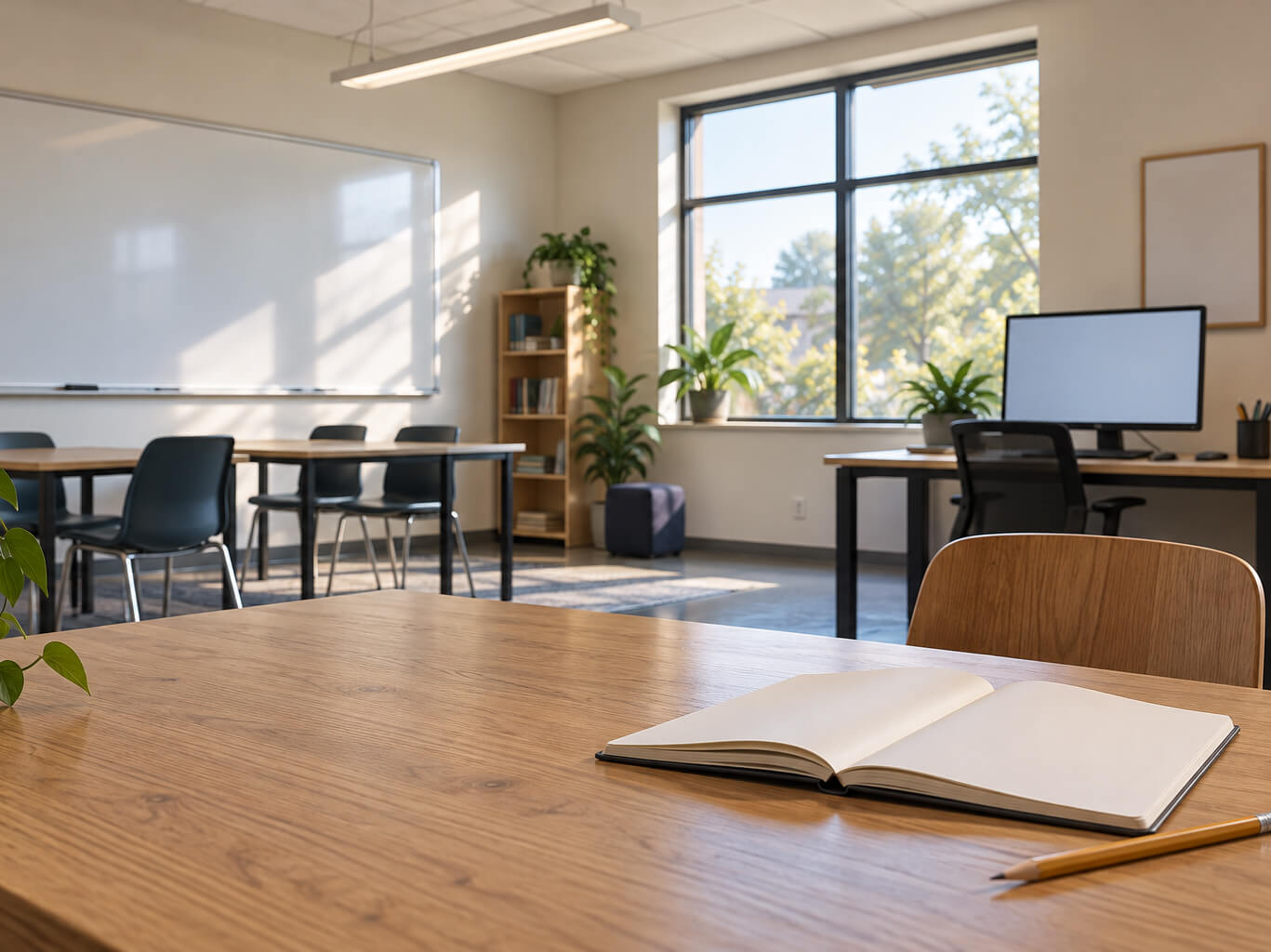
The room where you feel unwell is a clue, not a verdict. If discomfort repeatedly builds in a classroom or office, record what you notice there, when symptoms begin, and what changes when you leave or adjust the setting. Migraine environmental triggers are often discussed as if one light or one “stuffy” room explains an attack. A place-and-symptom record is more useful than guessing: it can show patterns worth discussing without proving what caused any individual episode. Guidance on identifying migraine triggers notes that apparent triggers may vary, combine, or even be confused with early symptoms of an attack.
The more useful first question is usually: What pattern is my day giving my sleep system? You do not need to diagnose yourself to notice that your daytime energy and nighttime readiness are out of sync.
Why a room can be a clue, not a diagnosis
A fluorescent-lit lecture hall or meeting room brings several conditions together. You might notice glare off a whiteboard, a flickering fixture, a bright window behind a screen, dense slides that demand sustained focus, noise, crowding, an odor, or a room that feels warm and stuffy. Write down what you observe; “stuffy” does not tell you whether there is a ventilation problem. A change in light sensitivity might also be part of an attack already developing rather than evidence that the room started it.
Information on photophobia and migraine explains that light sensitivity can occur with migraine and that both natural and artificial light can feel uncomfortable. It is not, by itself, a migraine diagnosis; light sensitivity can have other causes. Nor is visual discomfort just a “blue light” question. A review of migraine-related visual sensitivity discusses brightness, flicker, patterns, and color as distinct possible experiences. That does not establish which, if any, feature of your room matters.
For an older student, this might mean a seminar room feels harder on days when a projector and sunlight both hit the desk. For an office worker, the difficult spot may be a workstation beneath a fixture while the same task feels more manageable elsewhere. These comparisons help formulate a question; they do not turn one day’s experience into a cause-and-effect test.
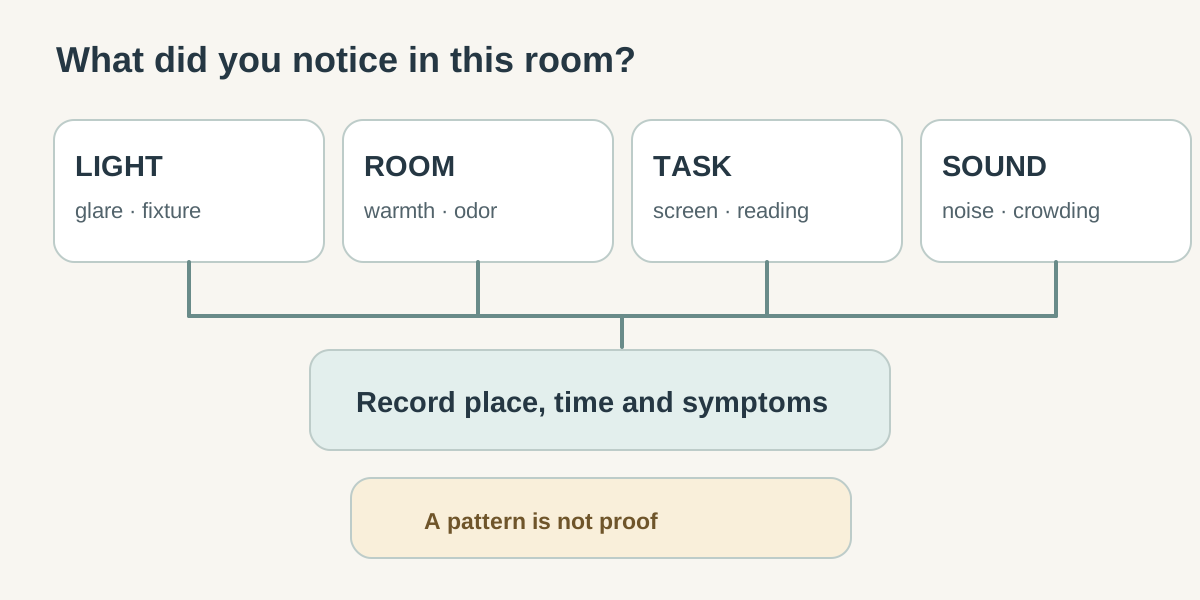
How to track a specific place without collecting endless data
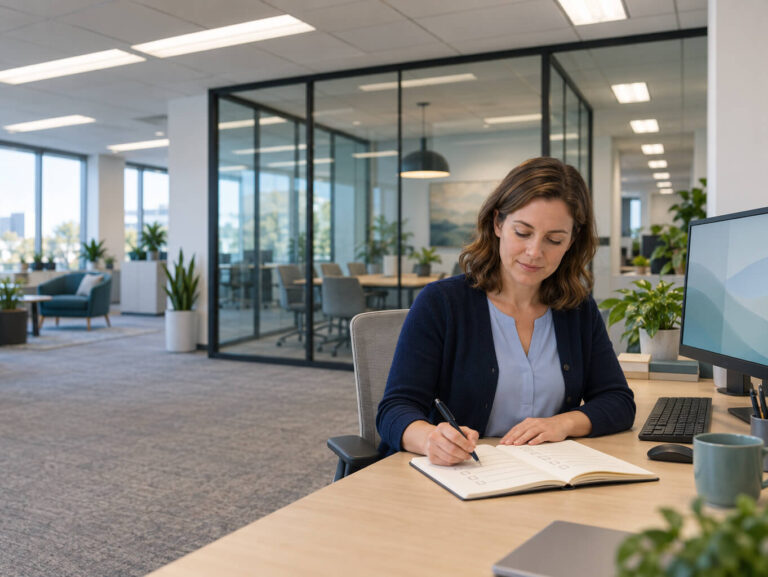
Use the same short entries for a week or two when feasible, including an ordinary or easier day for comparison. Record the time symptoms started, not just when you entered the room. If you feel too unwell to write, leave or seek help as needed and fill in only what you remember later; no log is worth staying in a distressing setting. A notebook or phone note is enough.
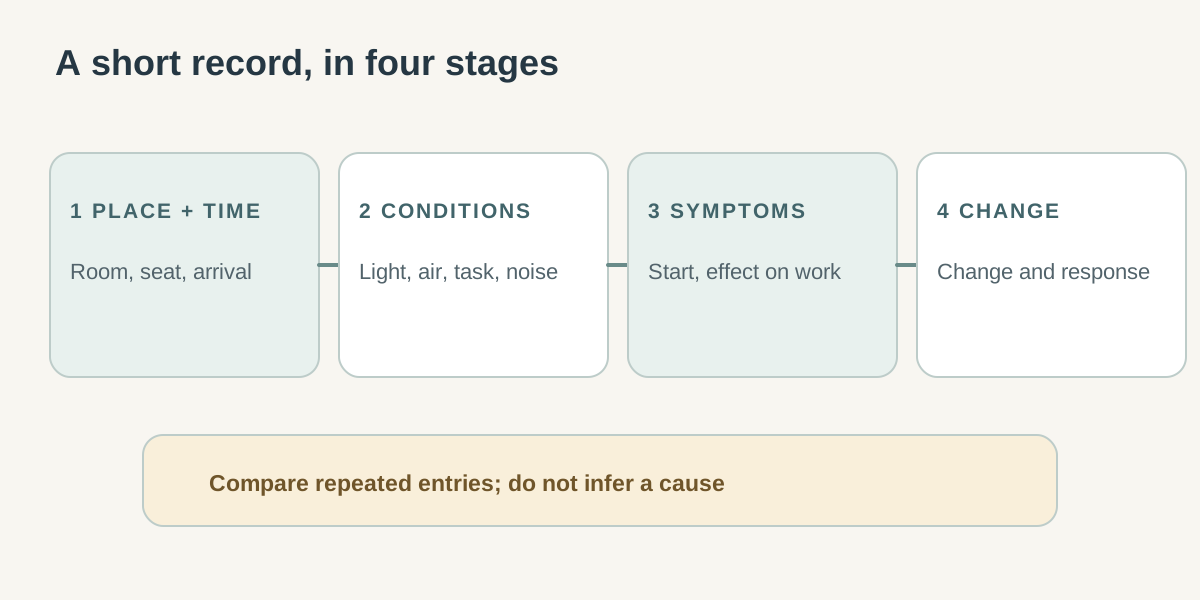
Example place-and-symptom log — copy and fill in:
timestamp/date: ______  location/seat: ______  arrival time: ______
lighting: source(s) ______  glare/flicker/patterns noticed ______
air/temperature/odor as observed (no diagnosis): ______
screen or task demand: ______  noise/crowding: ______
context, if relevant (sleep, meals, hydration, stress): ______
symptoms and start time: ______  severity/what I could not do: ______
what changed (seat, light, break, room, task): ______
what helped or did not help, and when: ______
A completed entry might say: “Tuesday, 10:15 a.m., back row of room 204; overhead lights and projector on, bright reflection on the board; room felt warm; working from slides. Light bothered me at 10:40 and I needed to stop reading at 11:05. I moved away from the reflection at 11:15; by noon reading felt easier.” That describes a sequence, not proof that the light or warmth caused the symptoms. Include a comparable class or work period when you can: it may show what differed, including sleep or workload outside the room.
Review several entries for recurring combinations: a particular seat and glare, a long screen task and few breaks, or discomfort that starts before you arrive. Do not discard an episode just because the expected factor was absent. A migraine trigger diary can support a conversation about patterns, but neither a single entry nor an improvement after one change confirms causation.
Choose one small place-based change to try
Start with a change that fits the observed difficulty and your setting, rather than attempting to eliminate every possible factor. If glare is the recurring observation, ask to change seats, move the screen, reposition a task light where permitted, or adjust how materials are displayed. If a fixture visibly flickers, report its location through the normal school or workplace facilities channel; you need not declare it the cause of a medical condition. For a room that feels warm or stuffy, ask whether an airflow or temperature check is possible rather than diagnosing the air yourself.
If sustained reading, a crowded room, or noise makes participation difficult, ask about brief scheduled breaks or access to a quieter, lower-stimulation space. In a classroom, an older student might request a seat with less board glare or a way to review slides away from the projector. At work, an employee might ask to try a different workstation or join a particular meeting remotely when appropriate. Feasibility depends on the activity and local procedures; none of these examples is a guaranteed accommodation or a substitute for medical assessment.
Try one manageable adjustment for an agreed period and record whether you can read, participate, or finish the task more comfortably. Several things may change at once in ordinary life, so even a good response is useful feedback, not a medical experiment or proof. If the first attempt does not help, revisit the record rather than assuming the concern is imaginary.
Ask for a trial, not agreement on a cause
A focused request has five parts: the setting, the functional difficulty, one proposed adjustment, a trial period, and what you will observe. You can share the relevant parts of your log without disclosing more health information than you choose. A teacher or student-support contact and a supervisor, facilities contact, HR, or accessibility office may handle different parts of the request; use the channel that fits your setting.
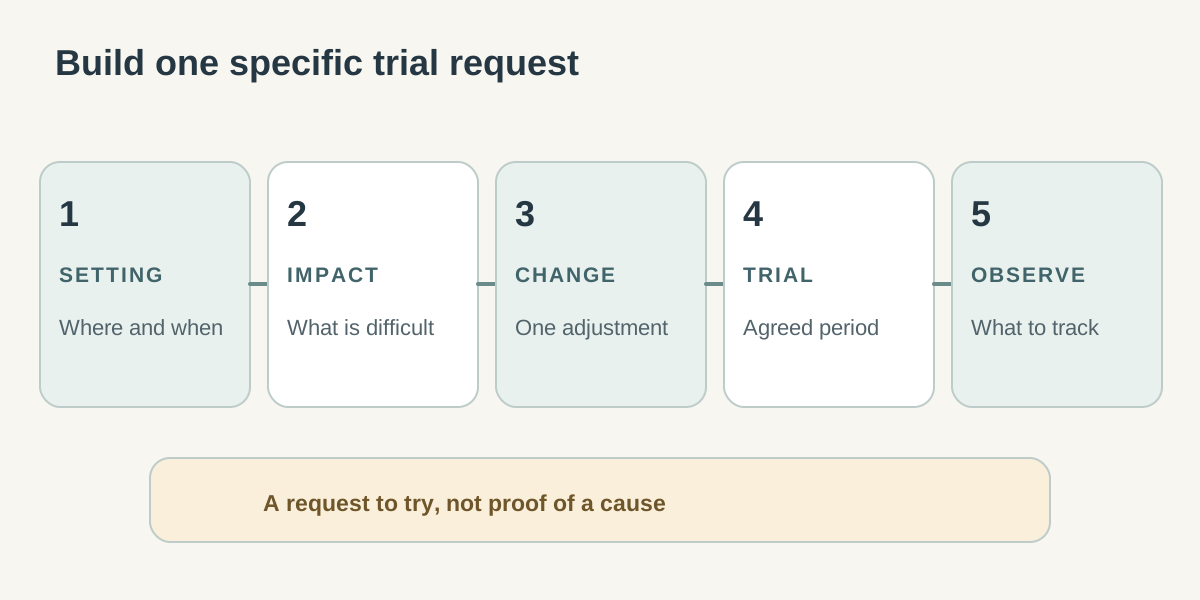
Example request wording (adapt it; this is not a legal template):
“In the afternoon class/weekly meeting in room 204, I sometimes have trouble reading the board or staying engaged when symptoms develop. Could I try sitting away from the reflection and receiving the slides in advance for two weeks? I can note whether I can follow the material and whether symptoms interrupt my participation, then we can review whether this change helps.”
For a visibly flickering fixture or a concern about room temperature, keep the facilities report separate and factual: identify the room, location, and time you noticed it, and follow the school’s or employer’s normal reporting procedures. You do not have to settle a medical or building-safety question to request that an observable issue be checked.
If symptoms persist, worsen, are severe or unexplained, or interfere with school or work, bring your record to an appropriate healthcare professional. Seek prompt medical assessment for new or unusual neurological or visual symptoms rather than assuming they are part of a familiar pattern. Environmental changes can make participation more manageable, but they do not establish a diagnosis or replace evaluation.
Pick the next class or meeting you already attend. Make one brief entry afterward, then identify the smallest adjustment you would be comfortable asking to trial. That gives you a concrete conversation to start, whether or not you ever identify a single “trigger.”
Disclaimer
This article is for educational purposes only and is not medical advice. Gloojo are not intended to diagnose, treat, cure, or prevent migraine, headaches, or any medical condition. If you have chronic migraine problems, take medication, are pregnant or nursing, or are considering migraine supplements, please speak with a qualified healthcare professional.