
Use the promo code to enjoy a 10% discount storewide.
Migraine Triggers Are More Complicated Than Most Lists Suggest — Here’s What Research Actually Shows

You have read the lists. You have avoided the foods, managed the stress, watched the weather forecast. And you still got a migraine. If that experience feels frustrating — or confusing, or vaguely like your own fault — the problem may not be your willpower. It may be the model of triggers you were given.
Migraine triggers are real, but they do not work like on/off switches. They are probabilistic contributors that interact with each other, with your current neurological state, and with timing you may not be able to see. Inconsistency is not a failure of avoidance — it is how triggers actually behave.
Why Doesn't the Same Trigger Cause an Attack Every Time?
This is the question that breaks the checklist model for most people. You had red wine on Saturday and felt fine. You had it again three weeks later and woke up with head pain and nausea. Same exposure, different outcome.
According to the American Migraine Foundation’s guidance on trigger identification, this is expected behavior, not an anomaly. Triggers are often inconsistent across attacks. A factor that contributes to one attack may have no apparent effect at another time, because your neurological threshold — the point at which your brain tips into an attack — is not fixed. It shifts with sleep, accumulated stress, and other variables you may not be tracking.
This means that a single exposure to a known trigger may land below your threshold on a good day and above it on a day when other factors have already lowered your defenses. The trigger did not change. Your threshold did.
When Triggers Stack Up
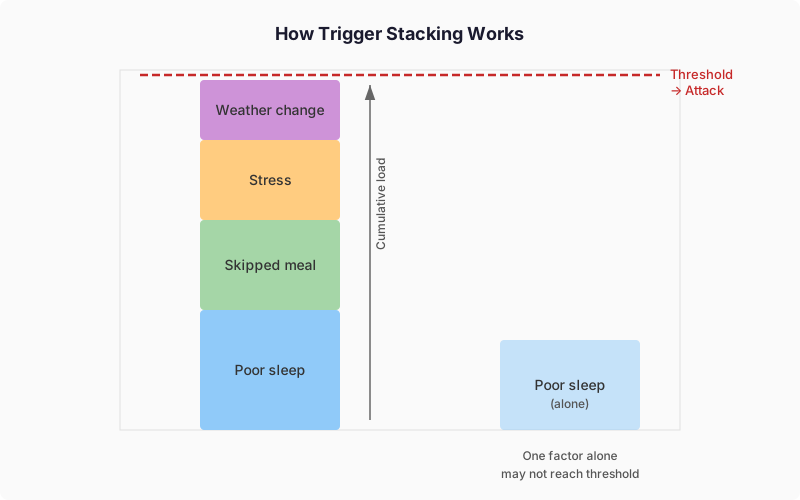
The concept of trigger stacking — sometimes called threshold effects — helps explain why an attack seems to appear out of nowhere, or why a “safe” day turns into a bad one.
Think of it as a cumulative load. Poor sleep on Tuesday does not guarantee a Wednesday migraine. But poor sleep on Tuesday, combined with a skipped meal, a stressful meeting, and a weather front moving through — that combination may cross your individual threshold. No single factor was “the trigger.” They stacked.
The AMF describes this as a combination effect: multiple triggers working together to produce an attack that none of them may have caused alone. This is why tracking one factor in isolation often fails to reveal a pattern. It is also why a food diary or a weather app, used by itself, may tell you less than you think.
This does not mean trigger tracking is pointless. It means the question to ask is not “did this one thing cause my migraine?” but rather “what was my total load when the attack happened?”
Triggers Can Change Over Time
Threshold fluctuation is not only a day-to-day phenomenon. Your trigger profile can also shift across longer periods. Expert guidance on migraine triggers notes that what reliably preceded attacks a few years ago may have less impact now.
This does not mean triggers are random or that tracking is futile. It means a pattern that held last year may not hold this year, and that is normal — not a sign you are doing something wrong.
Was It a Trigger — Or Was It Already Starting?
Here is where trigger identification gets genuinely tricky.
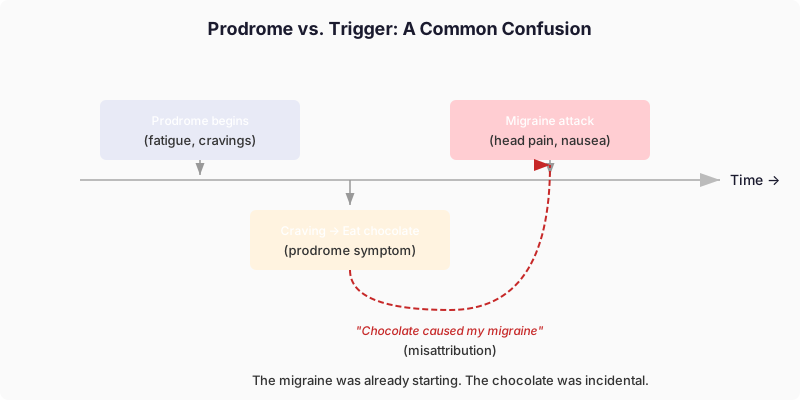
Migraine is not just a headache. It is a neurological event with distinct phases, and the earliest phase — called prodrome — can begin before any head pain. During prodrome, you might experience subtle changes: unusual fatigue, mood shifts, or specific food cravings.
That last one matters. Migraine’s attack phases include a prodrome stage in which cravings are a recognized symptom. So imagine this sequence: you crave chocolate in the afternoon, you eat some, and by evening you have a migraine. It is natural to conclude that chocolate was the trigger. But it is equally possible that the craving was a prodrome symptom — the migraine was already starting — and the chocolate was incidental.
This is called prodrome-trigger confusion, and the AMF’s trigger guidance specifically warns against it: not every exposure preceding an attack was its cause. Without awareness of the prodrome phase, it is easy to build a false pattern around something that was actually a symptom.
What a Migraine Diary Actually Tells You
So if triggers are inconsistent, if they stack in ways that are hard to isolate, and if some of what looks like a trigger is actually a symptom — is a diary still worth keeping?
Yes, but for a different reason than most trigger-list content suggests.
A diary is not a proof-of-causation tool. It is a pattern-recognition tool. Over time, it can help you notice clusters: attacks tend to follow certain combinations of circumstances, or accumulate after a run of poor sleep. These patterns form hypotheses — “when I have three or more of these factors in the same 48-hour window, my risk seems higher” — not certainties.
The value is in the honest observation, not in the false precision of labeling one factor as “my trigger.” A diary that captures sleep quality, stress levels, menstrual timing, weather changes, meals, and attack onset — without rushing to assign blame to any single entry — gives you a much richer picture than a checklist ever could.
If your diary reveals patterns that suggest a significant or worsening condition, or if attacks are becoming frequent enough to interfere with daily life, that is worth discussing with a healthcare provider. A diary is a useful conversation starter, not a substitute for professional evaluation.

The Emotional Layer
There is something quietly punishing about the trigger-list model. It implies that if you just avoid the right things, you will be fine. Which means that when an attack happens despite your best efforts, the unspoken conclusion is: you must have done something wrong.
This is not accurate, and it is not fair to you. Expert guidance explains that triggers are often inconsistent and combinational, that prodrome symptoms can masquerade as causes, and that individual thresholds shift with factors outside your control. Doing “everything right” and still having an attack is not evidence of failure. It is evidence that the model you were given was too simple.
Understanding this does not make migraine easier. But it can make the self-blame quieter. You are not bad at avoiding triggers. Triggers are genuinely hard to identify, and the neat checklists were never the whole picture.
A More Honest Way to Think About It
Migraine triggers are real contributors — not random, not imaginary, and not something to ignore. But they are also not predictable switches. They interact with each other, with your body’s current state, and with timing that may not be visible to you in the moment.
A symptom diary, kept with the understanding that it reveals patterns rather than proof, is still the most practical tool available for learning your own landscape. It will not give you certainty. But it can give you something better: a working hypothesis that evolves with your experience, rather than a checklist that blames you when it does not hold.
Disclaimer
This article is for educational purposes only and is not medical advice. Gloojo Glasses are not intended to diagnose, treat, cure, or prevent migraine, chronic headaches, photophobia, or any medical condition. Migraine is a complex neurological disorder. If you experience frequent or worsening attacks, severe head pain, or are considering changes to your migraine management plan, please speak with a qualified healthcare professional