Use the promo code to enjoy a 10% discount storewide.
Racing Thoughts Before Bed: A Gentle Way to Wind Down After Scrolling
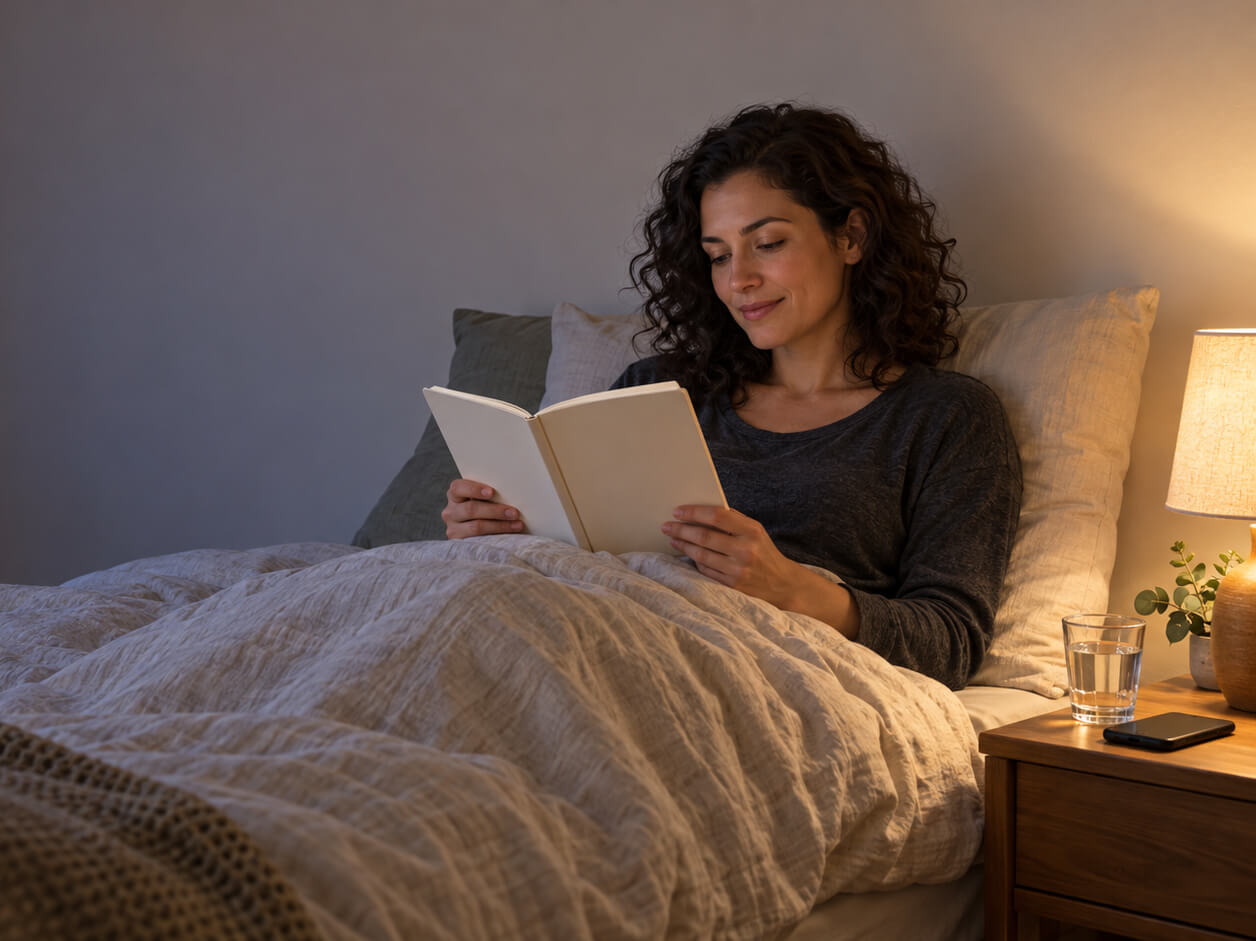
You meant to check one thing. Then you looked up and it was later than you planned, your phone was down, and your brain was still replaying headlines, messages, decisions, or tomorrow’s list.
If you have racing thoughts before bed, the frustrating part is often that you are tired. Tiredness and mental activation can coexist: your body may be ready for rest while your attention is still catching up with a fast, emotionally charged stream of information. That does not mean you lack discipline, and it does not mean a phone is the single cause of a difficult night.
The useful question is not “Why can’t I follow my rule?” It is “What is the smallest next shift that makes this evening less activating?” A gradual off-ramp tends to be more workable than trying to flip from intense scrolling straight into sleep.
Why a hard stop can feel harder than it sounds
A phone can bring together several things that keep the mind engaged: novelty, social tension, unfinished information, bright light, a familiar habit loop, and sometimes the urge to avoid an uncomfortable thought. The rest of the evening matters too—stress, worry, schedule changes, noise, room light, and concern about not sleeping can all be part of the picture. NHLBI’s overview of common contributors to sleep difficulty describes these as possible, interacting factors rather than a one-cause explanation.
That distinction matters when your mind is racing after phone at night. If you make the phone the villain, the only solution seems to be a perfect cutoff. If you see the problem as momentum, you have more than one place to intervene.
Try a reduce, replace, land runway tonight
You do not need to complete every step perfectly. Pick the first one that feels possible, then make the next transition a little easier.
1. Reduce the pull of the next scroll
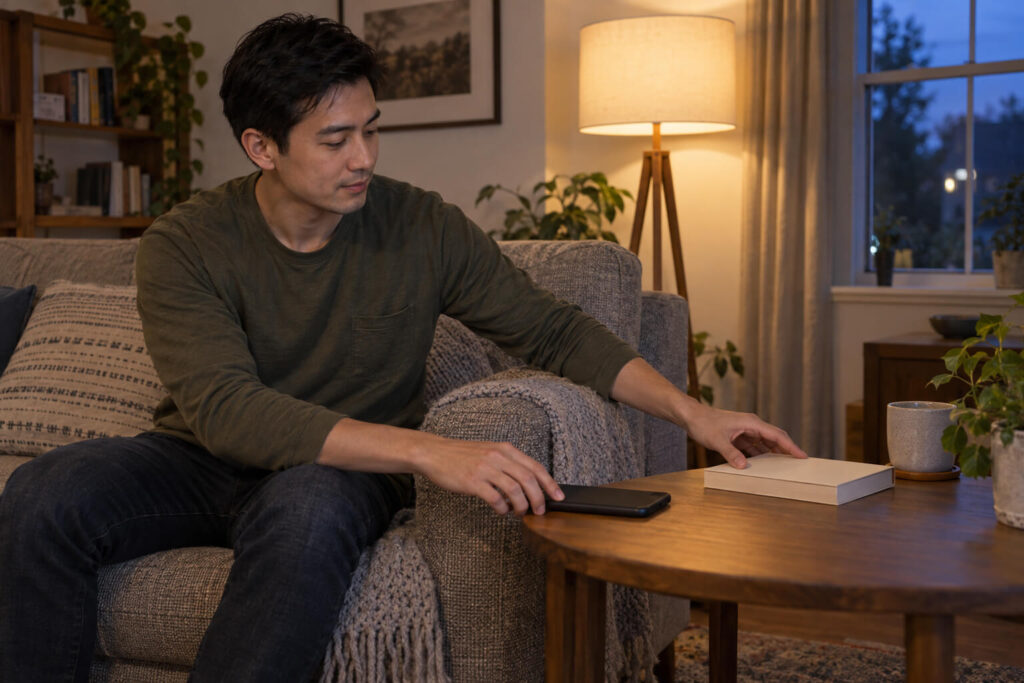
Before you ask yourself to stop, make continuing less automatic. Turn off nonessential notifications for the rest of the night, move the most activating app off the first screen, or plug the phone in a few steps from the bed. If an app limit is easy to override when you are depleted, treat that as information: the limit needs a companion, not more self-criticism.
A companion might be a glass of water you get before charging the phone, a bookmark already open to a calm read, or a note that says, “One small landing step.” The goal is not to create a flawless barrier. It is to add one beat between impulse and tap.
2. Reduce the intensity before you reduce the device
When stopping immediately feels impossible, change the kind of input first. Leave argumentative, urgent, or endlessly refreshed content for tomorrow. Switch to one finite, low-stakes task: replying to a practical message, choosing tomorrow’s clothes, listening to one familiar audio track, or reading a few pages of something without a feed.
This is a useful response to doomscrolling before bed because it lowers the emotional temperature without demanding an abrupt, all-or-nothing exit. Put a natural endpoint on the substitute—a song ending, a chapter, a five-minute timer—so it can become a bridge rather than a new way to stay awake.
3. Replace the screen with a short bridge activity
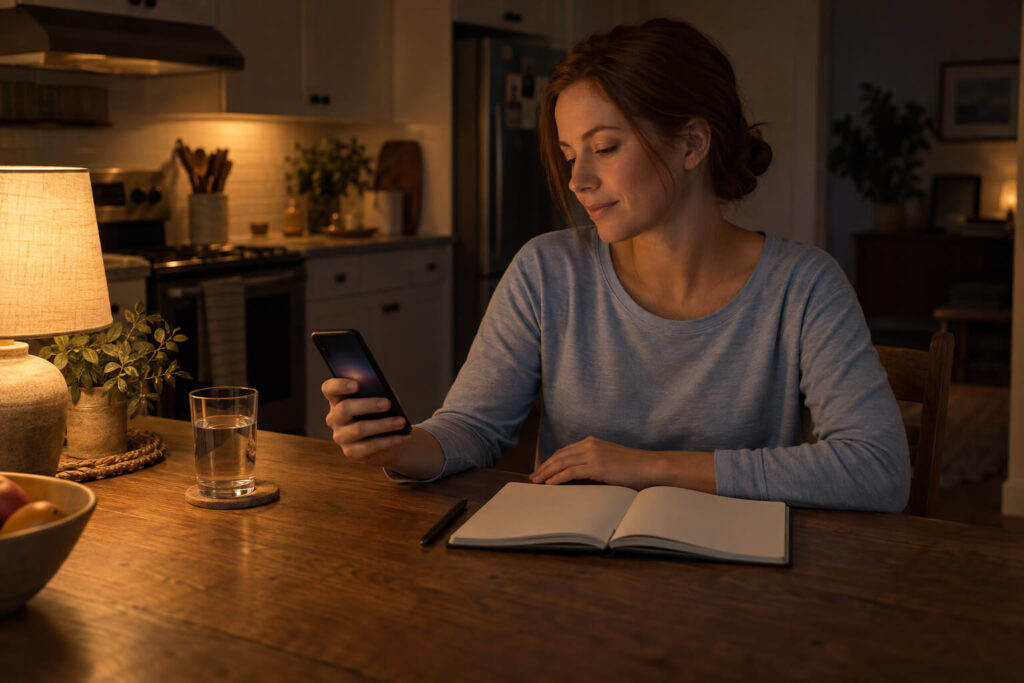
Once the content is quieter, give your attention somewhere else to land. Try a warm shower, gentle stretching, folding a few items of laundry under softer light, making a decaffeinated drink, or writing three unfinished thoughts on paper. The writing is not a productivity exercise; it is a place to set down what your mind keeps trying to hold.
If you cannot sleep after scrolling, avoid turning the bridge into a performance. You are not trying to force sleep on command. You are giving your nervous system fewer new things to process.
4. Lower the visual volume, not just the screen time
Dim the screen to a comfortable readable level, use your device’s evening display setting if it helps you tolerate lower brightness, and lower room lighting where practical. A darker room alone will not resolve every kind of worry or stimulation, but it can support a quieter transition. NHLBI’s practical sleep-habit guidance includes quiet time before bed, less bright artificial light, and a dark sleep environment as parts of a broader routine.
For an unavoidable evening screen—caregiving logistics, accessibility, a late work message, or a household task—aim for “less activating,” not “none.” Keep the task narrow, reduce brightness and glare, and return to the bridge activity when it is done. If you need to move around at home, keep enough light to see safely; bedtime light management should never compete with basic visibility.
5. Land after you get into bed
The transition is not finished when the phone is face down. Give yourself a two- or three-minute landing routine: relax your jaw and shoulders, notice the support under you, and write or mentally name the next practical step for any thought that keeps returning. Then redirect to something deliberately plain, such as the feeling of an exhale or a familiar, non-dramatic image.
If your attention jumps back to the phone, that is not a failed night. Repeat the smallest available step: put it out of reach, lower the light, or return to one quiet activity. Learning how to calm racing thoughts at night can be less about finding a magic technique than about reducing the number of things asking for your attention at once.
A quick way to choose an evening light option
If light feels like one useful part of your runway, choose the least restrictive option that matches what you still need to do. The table is about fit, not a promise that any one change will make you sleep.
| Option | What it can change | What it cannot change | Best fit tonight |
|---|---|---|---|
| Reduce or end screen use | Removes the device’s light and stops new content from arriving | Does not automatically settle worry, household demands, or other room light | You can switch to a non-screen bridge activity |
| Device display settings and lower brightness | Can make necessary screen use less bright and less visually intense | Does not remove stimulating content or all ambient light | You need a short, specific screen task |
| Softer room lighting | Reduces ambient brightness as you transition toward bed | Does not change the phone’s content or replace safe task lighting | You are doing a low-key activity at home |
| Tinted eyewear | Can reduce the light reaching your eyes while screens or home movement remain part of the evening | Does not mute alerts, settle rumination, or reliably improve sleep for everyone | You want an optional environmental layer alongside the other steps |
What about blue light glasses at night? They may be a practical light-management option for some routines, but the outcome evidence should stay modest. A Cochrane review of blue-light-filtering spectacle lenses found mixed results for sleep across the available randomized trials, so it is more accurate to treat eyewear as an optional adjunct than as a proven general sleep solution.
As one tint-based example, Night Ease sleep tints include an orange tint for easier evening screen use and movement around home, a red tint for stronger bedtime light control, and a dark red tint for the strictest light control. The dark red tint is extremely dark, so it belongs only in a safe, controlled, stationary pre-sleep setting—not while walking around, doing housework, caring for children, or navigating in low light. All three Night Ease sleep tints are unsuitable for driving or road use.
The tint choice does not need to become another rule. If your evening requires mobility, a darker option is not automatically better. The right question is whether a layer of light reduction helps your existing runway without making the evening less safe or less livable.
Make tonight an experiment, not a test
For the next 30 to 90 minutes, choose one action from each part of the runway:
Reduce: mute notifications or leave the most activating feed.
Replace: choose one finite, low-stakes task or non-screen activity.
Land: lower the visual volume and give yourself a brief, repeatable in-bed routine.
Tomorrow, notice what made the transition easier—not whether you achieved a perfect phone-free evening. That observation can guide your next small adjustment.
If trouble falling or staying asleep is persistent, is substantially affecting daytime functioning, or makes you concerned about a sleep disorder, it is worth discussing with a clinician rather than trying to self-manage indefinitely. NHLBI’s description of insomnia and daytime functioning can help frame why that boundary matters. For an occasional loud-minded night, though, a gentler runway may be a more useful place to start than another rule you have to fight.
Disclaimer
This article is for educational purposes only and is not medical advice. Gloojo Night Ease™ Sleep Glasses are not intended to diagnose, treat, cure, or prevent insomnia, sleep disorders, circadian rhythm disorders, or any medical condition. If you have chronic sleep problems, take medication, are pregnant or nursing, or are considering sleep supplements, please speak with a qualified healthcare professional.