
Use the promo code to enjoy a 10% discount storewide.
How to Stop Scrolling at Night: Put Your Phone Down With an Exit Plan

If you are exhausted but still refreshing a feed at 1 a.m., or much later, the problem is not necessarily that you lack discipline. Your phone is doing several jobs at once: alarm, contact line, entertainment, distraction, and default companion in bed. When it stays within reach, there is no clear moment when access ends.
The most workable answer to how to stop scrolling at night is to build an exit mechanism before you are tired: decide where the phone sleeps, preserve the few functions you truly need, make one final purposeful check, and have something else ready for the gap that follows. The goal is not to make yourself win an argument with the phone from bed. It is to make the next step obvious.
Start with where the phone will sleep
The best location is the one that makes in-bed scrolling inconvenient while still letting you handle your real responsibilities. Choose one setup for tonight rather than trying to negotiate it after you are already under the covers.
| If this is feasible for you | Put the phone here | Protect the essentials this way |
|---|---|---|
| You can separate the phone from the bedroom | Charge it outside the bedroom | Use a separate alarm clock; allow only the calls you need to receive |
| You need it in the bedroom | Put it across the room, not on a nightstand | Keep the alarm on and allow approved callers or emergency bypass if your phone supports it |
| You need it nearby for a specific reason | Park it in a closed drawer, bag, or other inconvenient spot | Decide the exact reason and endpoint before bed; do not leave feeds and notifications as the default |
A phone outside the bedroom is often the clearest boundary because there is no device to reach for half-awake. If that does not fit your household, placing it across the room is still meaningfully different from keeping it on the mattress or nightstand. The point is friction: picking it up should require a deliberate action, not a reflex.
“But I need my alarm”
An alarm clock instead of phone is the simplest way to separate waking up from scrolling. It can be an ordinary clock; it does not need to become another project. If you use your phone alarm, put the phone far enough away that you must leave the bed to silence it.
Whichever option you choose, test the alarm, volume, charging connection, and any backup before relying on it. A ten-second test at dinner is much easier than lying awake wondering whether the setup will work.
“What if someone needs to reach me?”
Being reachable does not require every notification or an open-ended feed. Before the phone is parked, set up the narrowest contact path that meets your situation: approved callers, favorites, or an emergency-bypass setting where supported. Let the people who may genuinely need you know how to reach you.
Then test that arrangement once. You are not trying to become unreachable; you are separating urgent contact from unlimited access.
Make the last check small and specific
Many bedtime phone rules fail because they say only “stop using it.” A last check works better when it has both a purpose and an end.
For example: “At 10:30, I will spend five minutes checking tomorrow’s logistics and messages from the people I am expecting to hear from. Then I will plug in my phone in the kitchen.” Your own time can be earlier, later, or shorter. What matters is that the check is for messages or logistics, not a reward for finishing the day with more browsing.
When the timer ends, physically carry the phone to its charging spot. Do not bring it to bed for one more look. That handoff is the exit: check, park, replace.
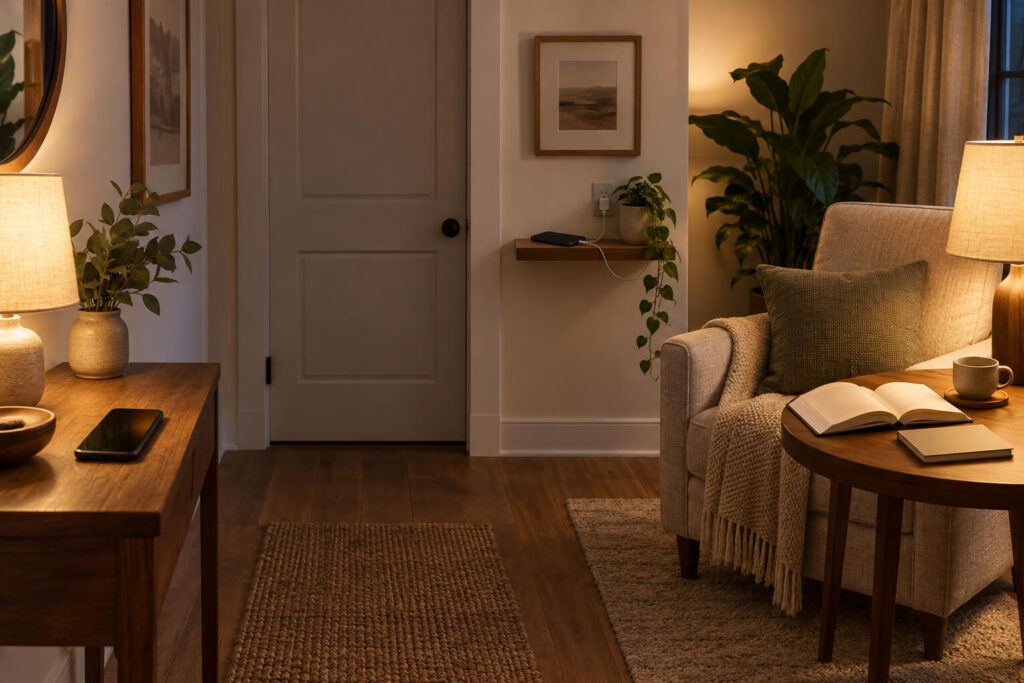
Prepare what happens after the phone is parked
The empty few minutes after you put your phone down before bed can be the hardest part. If nothing is ready, your brain will reach for the easiest familiar option. Give it a quieter, low-effort alternative.
Choose one or two activities and set them out before your last check:
a paper book, magazine, or puzzle that is easy to resume;
a short hygiene routine you have already decided on;
a notebook for a quick brain-dump or tomorrow list;
gentle stretching or breathing if that feels comfortable for you;
a simple non-phone wind-down activity you genuinely do not dread.
There is no universally calming replacement. The useful one is available, low-stimulation enough for your evening, and does not send you back to the phone to get started. If you have been asking what to do before bed instead of your phone, start small: pick one option and leave it where your hand would normally reach for the device.
Keep necessary screen use bounded and light in its place
Sometimes you really do need a short screen task before bed: confirming an arrival time, checking a caregiving message, or handling a time-sensitive detail. Do that task on purpose, with a defined endpoint, then park the phone. Lowering the surrounding brightness can make that brief use less jarring than using a bright room at night, but it is not an exit plan by itself.
The National Heart, Lung, and Blood Institute includes quiet time before bed and avoiding bright artificial light among its healthy sleep habits. Treat that guidance as support for the wider routine: dim the environment if it helps, complete the necessary task, and end access. A screen setting does not turn continued scrolling into a sleep strategy.
Use a reset when you pick it back up
If you pick up the phone automatically, do not turn it into proof that the plan failed. Use a short reset:
Notice that the phone is back in your hand.
Put it back in its charging spot without finishing the feed.
Return to the replacement activity you prepared.
Adjust one piece of the setup tomorrow if the phone was too easy to reach.
That is data, not a character verdict. Maybe the charging spot needs to be farther away, the last check needs a timer, or the replacement activity needs to be more inviting.
Your first-night checklist
Set this up before bedtime, not while you are already scrolling:
Choose where to charge your phone at night: outside the bedroom, across the room, or in a closed inconvenient spot.
Choose the alarm plan: a separate alarm clock or a phone alarm you will have to get up to silence.
Choose the essential-contact exception: approved callers, favorites, or emergency bypass where available.
Test the alarm and contact setup before relying on it.
Write your last check: its time, purpose, and endpoint.
Put one replacement activity in reach before the last check begins.
When the last check ends, charge the phone and start the replacement. Do not take the phone back to bed.
If you can’t put your phone down at night, try this setup for several evenings before deciding it does not fit. You are testing a system, not trying to perform perfect restraint on night one.
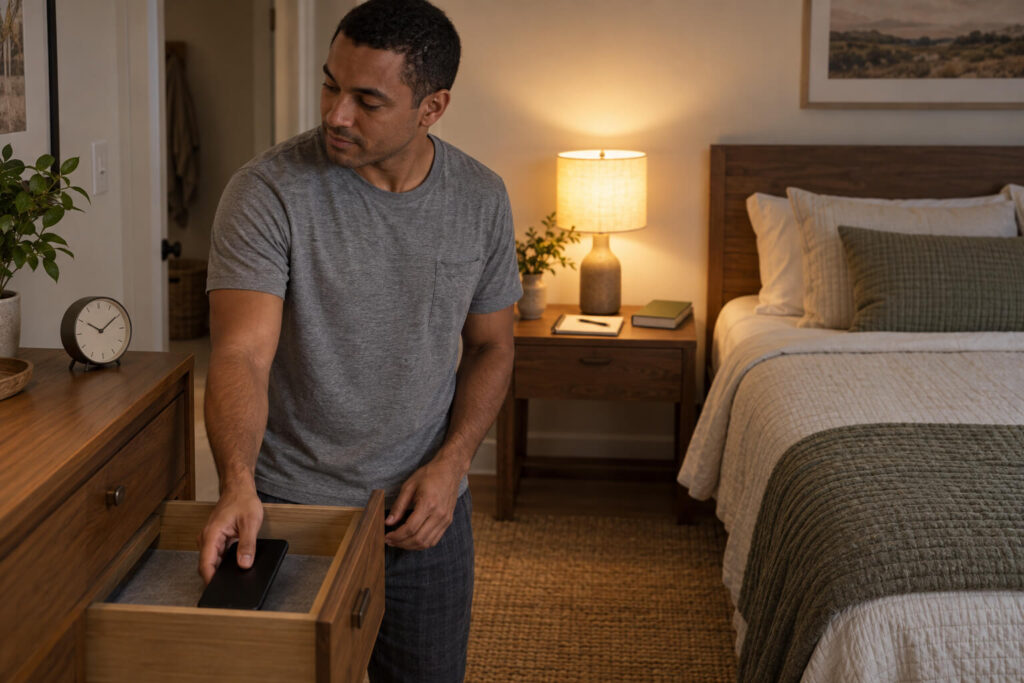
Troubleshoot the predictable sticking points
“I am anxious I will sleep through the alarm.” Test the alarm early, use a backup if you have one, and place it where you must stand up to turn it off. Alarm confidence makes the phone’s overnight location easier to change.
“I am waiting for an important message.” Define who can reach you and how. Keep that route available, but do not treat every app as part of the exception.
“I picked it up without thinking.” Add distance or a container. The next night, make the replacement activity even easier to begin than unlocking the phone.
If sleep difficulty keeps happening despite reasonable changes, is affecting your daytime functioning, or feels unmanageable, consider discussing the pattern with a healthcare professional. Sleep problems can have interacting contributors rather than one single cause, as the NHLBI notes in its overview of possible insomnia contributors.
Tonight, choose the phone’s sleeping place, test your alarm and essential-contact route, and write one last-check rule. That is enough to create an exit you can actually use.
Disclaimer
This article is for educational purposes only and is not medical advice. Gloojo Night Ease™ Sleep Glasses are not intended to diagnose, treat, cure, or prevent insomnia, sleep disorders, circadian rhythm disorders, or any medical condition. If you have chronic sleep problems, take medication, are pregnant or nursing, or are considering sleep supplements, please speak with a qualified healthcare professional.